
Drug Information
Drug (ID: DG00131) and It's Reported Resistant Information
| Name |
Fluconazole
|
||||
|---|---|---|---|---|---|
| Synonyms |
Afungil; Alflucoz; Baten; Beagyne; Biocanol; Biozolene; Canzol; Cryptal; Diflazon; Diflucan; Dimycon; Elazor; FCZ; FLCZ; Flucazol; FlucoLich; Flucobeta; Fluconazol; Fluconazolum; Flucostat; Flukezol; Flunazul; Flunizol; Fluzone; Forcan; Fuconal; Fungata; Lavisa; Loitin; Mutum; Neofomiral; Oxifugol; Oxifungol; Pritenzol; Solacap; Syscan; TPF; Triflucan; Zemyc; Zoltec; Zonal; AbZ Brand of Fluconazole; Aliud Brand of Fluconazole; Alpharma Brand of Fluconazole; Apo Fluconazole; Apotex Brand of Fluconazole; Armstrong Brand of Fluconazole; Betapharm Brand of Fluconazole; Chemia Brand of Fluconazole; Ct Arzneimittel Brand of Fluconazole; Effik Brand of Fluconazole; Fluc Hexal; Fluconazol AL; Fluconazol AbZ; Fluconazol Isis; Fluconazol Stada; Fluconazol [Spanish]; Fluconazol ratiopharm; Fluconazol von ct; Fluconazolum [Latin]; Hexal Brand of Fluconazole; Lesvi Brand of Fluconazole; Lichtenstein Brand of Fluconazole; Mack Brand of Fluconazole; Pfizer Brand of Fluconazole; Pfleger Brand of Fluconazole; Ratiopharm Brand of Fluconazole; SAT Brand of Fluconazole; Silanes Brand of Fluconazole; Stada Brand of Fluconazole; Vita Brand of Fluconazole; F0677; Fluconazole in combination with MGCD290; UK 49858; UK49858; Alfumet (TN); Apo-Fluconazole; Ct-Arzneimittel Brand of Fluconazole; DIFLUCAN IN DEXTROSE 5% IN PLASTIC CONTAINER; DRG-0005; Diflucan (TN); Fluconazol-Isis; Fluconazol-ratiopharm; Fluconazole & Bovine Lactoferrin; Fluconazole & Human recombinant granulocyte colony stimulating factor; Fluconazole & hGCSF; Fluconazole in dextrose 5% in plastic container; Flucytosine & Nyotran; GL663142 & Fluconazole; KS-1059; Trican (TN); UK-49858; DIFLUCAN IN SODIUM CHLORIDE 0.9%; DIFLUCAN IN SODIUM CHLORIDE 0.9%IN PLASTIC CONTAINER; Fluconazole in sodium chloride 0.9%; Fluconazole in sodium chloride 0.9% in plastic container; Flucytosine & Nyotran(Liposomal Nystatin); XMP.284 & Fluconazole; XMP.366 & Fluconazole; XMP.391 & Fluconazole; Diflucan, Trican, Alfumet, Fluconazole; Fluconazole & MC-510,011; Fluconazole (JAN/USAN/INN); Fluconazole [USAN:INN:BAN:JAN]; 2,4-Difluoro-alpha,alpha-bis(1H-1,2,4-triazol-1-ylmethyl)benzyl alcohol; 2,4-difluoro-,1-bis(1H-1,2,4-triazol-1-ylmethyl)benzyl alcohol; 2-(2,4-DIFLUOROPHENYL)-1,3-DI(1H-1,2,4-TRIAZOL-1-YL)PROPAN-2-OL; 2-(2,4-Difluoro-phenyl)-1,3-bis-[1,2,4]triazol-1-yl-propan-2-ol; 2-(2,4-Difluorophenyl)-1,3-bis(1H-1,2,4-triazol-1-yl)-2-propanol; 2-(2,4-Difluorophenyl)-1,3-bis(1H-1,2,4-triazol-1-yl)propan-2-ol; 2-(2,4-Difluorophenyl)-1,3-di-1H-1,2,4-triazol-1-ylpropan-2-ol; 2-(2,4-difluorophenyl)-1,3-bis(1,2,4-triazol-1-yl)propan-2-ol
Click to Show/Hide
|
||||
| Indication |
In total 1 Indication(s)
|
||||
| Structure |
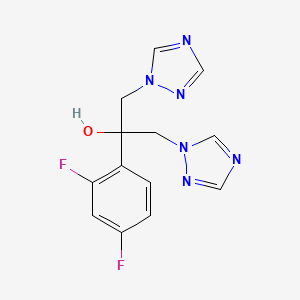
|
||||
| Drug Resistance Disease(s) |
Disease(s) with Resistance Information Discovered by Cell Line Test for This Drug
(3 diseases)
 Bacteremia [ICD-11: MA15]
[3]
Cystic fibrosis [ICD-11: CA25]
[7]
Urinary tract infection [ICD-11: GC08]
[11]
Disease(s) with Clinically Reported Resistance for This Drug
(6 diseases)
Cryptococcosis [ICD-11: 1F27]
[6]
Fungal meningitis [ICD-11: 1D01]
[6]
Histoplasmosis [ICD-11: 1F2A]
[8]
Lichen planus [ICD-11: EA91]
[9]
Mycotic vaginitis [ICD-11: 1F2Y]
[10]
Disease(s) with Resistance Information Validated by in-vivo Model for This Drug
(1 diseases)
Candidosis [ICD-11: 1F23]
[12]
|
||||
| Target | Candida Cytochrome P450 51 (Candi ERG11) | CP51_CANAL | [1] | ||
| Click to Show/Hide the Molecular Information and External Link(s) of This Drug | |||||
| Formula |
C13H12F2N6O
|
||||
| IsoSMILES |
C1=CC(=C(C=C1F)F)C(CN2C=NC=N2)(CN3C=NC=N3)O
|
||||
| InChI |
1S/C13H12F2N6O/c14-10-1-2-11(12(15)3-10)13(22,4-20-8-16-6-18-20)5-21-9-17-7-19-21/h1-3,6-9,22H,4-5H2
|
||||
| InChIKey |
RFHAOTPXVQNOHP-UHFFFAOYSA-N
|
||||
| PubChem CID | |||||
| ChEBI ID | |||||
| TTD Drug ID | |||||
| VARIDT ID | |||||
| INTEDE ID | |||||
| DrugBank ID | |||||
Type(s) of Resistant Mechanism of This Drug
 ADTT: Aberration of the Drug's Therapeutic Target
 IDUE: Irregularity in Drug Uptake and Drug Efflux
 UAPP: Unusual Activation of Pro-survival Pathway
Drug Resistance Data Categorized by Their Corresponding Diseases
ICD-01: Infectious/parasitic diseases
Fungal meningitis [ICD-11: 1D01]
| Drug Resistance Data Categorized by Their Corresponding Mechanisms | ||||
|
Aberration of the Drug's Therapeutic Target (ADTT)
|
||||
| Key Molecule: Lanosterol 14-alpha demethylase (ERG11) | [6] | |||
| Resistant Disease | Cryptococcal meningitis [ICD-11: 1D01.0] | |||
| Molecule Alteration | Missense mutation | p.G484S (c.G1855T) |
||
| Experimental Note | Identified from the Human Clinical Data | |||
| In Vitro Model | Cryptococcus neoformans stiain CN-5 | 5207 | ||
| Experiment for Molecule Alteration |
Genomic sequence assay | |||
| Experiment for Drug Resistance |
Microdilution and E-test methods assay | |||
| Mechanism Description | A point mutation (G1855T) in the ERG11 gene was detected in the FCZ-resistant isolate (CN-5) only. And this mutation is responsible for the amino acid substitution glycine 484 for serine (G484S) in the ERG11 deduced protein sequence of C. neoformans. | |||
| Drug Sensitivity Data Categorized by Their Corresponding Mechanisms | ||||
|
Irregularity in Drug Uptake and Drug Efflux (IDUE)
|
||||
| Key Molecule: ABC transporter (ABCT) | [13] | |||
| Sensitive Disease | Cryptococcal meningitis [ICD-11: 1D01.0] | |||
| Molecule Alteration | Expression | Down-regulation |
||
| Experimental Note | Identified from the Human Clinical Data | |||
| In Vitro Model | Cryptococcus neoformans stiain BPY22.17 | 5207 | ||
| Experiment for Molecule Alteration |
Southern hybridization analysis; Northern hybridization analysis | |||
| Experiment for Drug Resistance |
Rhodamine 6G accumulation assay; M27-A assay | |||
| Mechanism Description | We found that the MIC to fluconazole in the knock-out mutant cnafr reduced 16-fold compared to the parent strain BPY22.17, but was nearly equal to that of the matched fluconazole-susceptible strain BPY22 (although was still somewhat less susceptible than strain BPY22). | |||
Candidosis [ICD-11: 1F23]
| Drug Resistance Data Categorized by Their Corresponding Mechanisms | ||||
|
Aberration of the Drug's Therapeutic Target (ADTT)
|
||||
| Key Molecule: Lanosterol 14-alpha demethylase (ERG11) | [1], [2] | |||
| Resistant Disease | Recurrent oropharyngeal candidiasis [ICD-11: 1F23.6] | |||
| Molecule Alteration | Missense mutation | p.S405F |
||
| Experimental Note | Identified from the Human Clinical Data | |||
| In Vitro Model | Candida albicans strain C470 | 5476 | ||
| Candida albicans strain C478 | 5476 | |||
| Experiment for Molecule Alteration |
DNA sequencing assay | |||
| Experiment for Drug Resistance |
Broth microdilution assay | |||
| Mechanism Description | Seventeen of the 38 isolates analyzed exhibited cross-resistance to fluconazole (MIC, >=64 ug/ml) and voriconazole (in the absence of established breakpoints, we labeled an isolate resistant to voriconazole if the MIC was >1 ug/ml). Sixteen of the 17 isolates (the exception was C587) exhibited the same pattern of mutations in ERG11; a substitution close to the N terminus of the protein (k128T, Y132H, or Y257H) together with a substitution towards the C terminus of the protein (G405F, G448V, G450E, or G464S). | |||
| Key Molecule: Lanosterol 14-alpha demethylase (ERG11) | [1], [2] | |||
| Resistant Disease | Recurrent oropharyngeal candidiasis [ICD-11: 1F23.6] | |||
| Molecule Alteration | Missense mutation | p.G464S |
||
| Experimental Note | Identified from the Human Clinical Data | |||
| In Vitro Model | Candida albicans strain C587 | 5476 | ||
| Experiment for Molecule Alteration |
DNA sequencing assay | |||
| Experiment for Drug Resistance |
Broth microdilution assay | |||
| Mechanism Description | Seventeen of the 38 isolates analyzed exhibited cross-resistance to fluconazole (MIC, >=64 ug/ml) and voriconazole (in the absence of established breakpoints, we labeled an isolate resistant to voriconazole if the MIC was >1 ug/ml). Sixteen of the 17 isolates (the exception was C587) exhibited the same pattern of mutations in ERG11; a substitution close to the N terminus of the protein (k128T, Y132H, or Y257H) together with a substitution towards the C terminus of the protein (G405F, G448V, G450E, or G464S). | |||
| Key Molecule: Lanosterol 14-alpha demethylase (ERG11) | [14] | |||
| Resistant Disease | Candida albicans infection [ICD-11: 1F23.Y] | |||
| Molecule Alteration | Missense mutation | p.A114S+p.Y257H+p.G487T+p.T916C |
||
| Experimental Note | Identified from the Human Clinical Data | |||
| In Vitro Model | Candida albicans strain | 5476 | ||
| Experiment for Molecule Alteration |
DNA sequencing assay | |||
| Experiment for Drug Resistance |
M27-A2 broth dilution method assay | |||
| Mechanism Description | Amino acid changes in ERG11 may contribute to Candida albicans emerging fluconazole resistance. | |||
| Key Molecule: Lanosterol 14-alpha demethylase (ERG11) | [14] | |||
| Resistant Disease | Candida albicans infection [ICD-11: 1F23.Y] | |||
| Molecule Alteration | Missense mutation | p.M140R |
||
| Experimental Note | Identified from the Human Clinical Data | |||
| In Vitro Model | Candida albicans strain | 5476 | ||
| Experiment for Molecule Alteration |
DNA sequencing assay | |||
| Experiment for Drug Resistance |
M27-A2 broth dilution method assay | |||
| Mechanism Description | Amino acid changes in ERG11 may contribute to Candida albicans emerging fluconazole resistance. | |||
| Key Molecule: Lanosterol 14-alpha demethylase (ERG11) | [14] | |||
| Resistant Disease | Candida albicans infection [ICD-11: 1F23.Y] | |||
| Molecule Alteration | Missense mutation | p.K161N |
||
| Experimental Note | Identified from the Human Clinical Data | |||
| In Vitro Model | Candida albicans strain | 5476 | ||
| Experiment for Molecule Alteration |
DNA sequencing assay | |||
| Experiment for Drug Resistance |
M27-A2 broth dilution method assay | |||
| Mechanism Description | Amino acid changes in ERG11 may contribute to Candida albicans emerging fluconazole resistance. | |||
| Key Molecule: Lanosterol 14-alpha demethylase (ERG11) | [14] | |||
| Resistant Disease | Candida albicans infection [ICD-11: 1F23.Y] | |||
| Molecule Alteration | Missense mutation | p.R163T |
||
| Experimental Note | Identified from the Human Clinical Data | |||
| In Vitro Model | Candida albicans strain | 5476 | ||
| Experiment for Molecule Alteration |
DNA sequencing assay | |||
| Experiment for Drug Resistance |
M27-A2 broth dilution method assay | |||
| Mechanism Description | Amino acid changes in ERG11 may contribute to Candida albicans emerging fluconazole resistance. | |||
| Key Molecule: Lanosterol 14-alpha demethylase (ERG11) | [14] | |||
| Resistant Disease | Candida albicans infection [ICD-11: 1F23.Y] | |||
| Molecule Alteration | Missense mutation | p.E165K |
||
| Experimental Note | Identified from the Human Clinical Data | |||
| In Vitro Model | Candida albicans strain | 5476 | ||
| Experiment for Molecule Alteration |
DNA sequencing assay | |||
| Experiment for Drug Resistance |
M27-A2 broth dilution method assay | |||
| Mechanism Description | Amino acid changes in ERG11 may contribute to Candida albicans emerging fluconazole resistance. | |||
| Key Molecule: Lanosterol 14-alpha demethylase (ERG11) | [14] | |||
| Resistant Disease | Candida albicans infection [ICD-11: 1F23.Y] | |||
| Molecule Alteration | Missense mutation | p.D225Y |
||
| Experimental Note | Identified from the Human Clinical Data | |||
| In Vitro Model | Candida albicans strain | 5476 | ||
| Experiment for Molecule Alteration |
DNA sequencing assay | |||
| Experiment for Drug Resistance |
M27-A2 broth dilution method assay | |||
| Mechanism Description | Amino acid changes in ERG11 may contribute to Candida albicans emerging fluconazole resistance. | |||
| Key Molecule: Lanosterol 14-alpha demethylase (ERG11) | [14] | |||
| Resistant Disease | Candida albicans infection [ICD-11: 1F23.Y] | |||
| Molecule Alteration | Missense mutation | p.D225H |
||
| Experimental Note | Identified from the Human Clinical Data | |||
| In Vitro Model | Candida albicans strain | 5476 | ||
| Experiment for Molecule Alteration |
DNA sequencing assay | |||
| Experiment for Drug Resistance |
M27-A2 broth dilution method assay | |||
| Mechanism Description | Amino acid changes in ERG11 may contribute to Candida albicans emerging fluconazole resistance. | |||
| Key Molecule: Lanosterol 14-alpha demethylase (ERG11) | [14] | |||
| Resistant Disease | Candida albicans infection [ICD-11: 1F23.Y] | |||
| Molecule Alteration | Missense mutation | p.F449Y |
||
| Experimental Note | Identified from the Human Clinical Data | |||
| In Vitro Model | Candida albicans strain | 5476 | ||
| Experiment for Molecule Alteration |
DNA sequencing assay | |||
| Experiment for Drug Resistance |
M27-A2 broth dilution method assay | |||
| Mechanism Description | Amino acid changes in ERG11 may contribute to Candida albicans emerging fluconazole resistance. | |||
| Key Molecule: Lanosterol 14-alpha demethylase (ERG11) | [14] | |||
| Resistant Disease | Candida albicans infection [ICD-11: 1F23.Y] | |||
| Molecule Alteration | Missense mutation | p.I471T |
||
| Experimental Note | Identified from the Human Clinical Data | |||
| In Vitro Model | Candida albicans strain | 5476 | ||
| Experiment for Molecule Alteration |
DNA sequencing assay | |||
| Experiment for Drug Resistance |
M27-A2 broth dilution method assay | |||
| Mechanism Description | Amino acid changes in ERG11 may contribute to Candida albicans emerging fluconazole resistance. | |||
| Key Molecule: Lanosterol 14-alpha demethylase (ERG11) | [14] | |||
| Resistant Disease | Candida albicans infection [ICD-11: 1F23.Y] | |||
| Molecule Alteration | Missense mutation | p.Q474K |
||
| Experimental Note | Identified from the Human Clinical Data | |||
| In Vitro Model | Candida albicans strain | 5476 | ||
| Experiment for Molecule Alteration |
DNA sequencing assay | |||
| Experiment for Drug Resistance |
M27-A2 broth dilution method assay | |||
| Mechanism Description | Amino acid changes in ERG11 may contribute to Candida albicans emerging fluconazole resistance. | |||
| Key Molecule: Lanosterol 14-alpha demethylase (ERG11) | [14] | |||
| Resistant Disease | Candida albicans infection [ICD-11: 1F23.Y] | |||
| Molecule Alteration | Missense mutation | p.P375Q |
||
| Experimental Note | Identified from the Human Clinical Data | |||
| In Vitro Model | Candida albicans strain | 5476 | ||
| Experiment for Molecule Alteration |
DNA sequencing assay | |||
| Experiment for Drug Resistance |
M27-A2 broth dilution method assay | |||
| Mechanism Description | Amino acid changes in ERG11 may contribute to Candida albicans emerging fluconazole resistance. | |||
| Key Molecule: Lanosterol 14-alpha demethylase (ERG11) | [14] | |||
| Resistant Disease | Candida albicans infection [ICD-11: 1F23.Y] | |||
| Molecule Alteration | Missense mutation | p.R381I |
||
| Experimental Note | Identified from the Human Clinical Data | |||
| In Vitro Model | Candida albicans strain | 5476 | ||
| Experiment for Molecule Alteration |
DNA sequencing assay | |||
| Experiment for Drug Resistance |
M27-A2 broth dilution method assay | |||
| Mechanism Description | Amino acid changes in ERG11 may contribute to Candida albicans emerging fluconazole resistance. | |||
| Key Molecule: Lanosterol 14-alpha demethylase (ERG11) | [14] | |||
| Resistant Disease | Candida albicans infection [ICD-11: 1F23.Y] | |||
| Molecule Alteration | Missense mutation | p.K119N |
||
| Experimental Note | Identified from the Human Clinical Data | |||
| In Vitro Model | Candida albicans strain | 5476 | ||
| Experiment for Molecule Alteration |
DNA sequencing assay | |||
| Experiment for Drug Resistance |
M27-A2 broth dilution method assay | |||
| Mechanism Description | Amino acid changes in ERG11 may contribute to Candida albicans emerging fluconazole resistance. | |||
| Key Molecule: Lanosterol 14-alpha demethylase (ERG11) | [15] | |||
| Resistant Disease | Candida albicans infection [ICD-11: 1F23.Y] | |||
| Molecule Alteration | Missense mutation | p.Y132F+p.Y205E+p.Y257H+p.D116E+p.K143Q |
||
| Experimental Note | Identified from the Human Clinical Data | |||
| In Vitro Model | Candida albicans strain | 5476 | ||
| Experiment for Molecule Alteration |
DNA sequencing assay | |||
| Experiment for Drug Resistance |
M27-A2 broth dilution method assay | |||
| Mechanism Description | We observed that substitutions A114S, Y132H, Y132F, k143R, Y257H, and a new k143Q substitution contributed to significant increases ( fourfold) in fluconazole and voriconazole resistance; changes in itraconazole resistance were not significant (twofold). | |||
| Key Molecule: Lanosterol 14-alpha demethylase (ERG11) | [15] | |||
| Resistant Disease | Candida albicans infection [ICD-11: 1F23.Y] | |||
| Molecule Alteration | Missense mutation | p.Y132F+p.Y205E+p.V437I+p.D116E+p.K143Q |
||
| Experimental Note | Identified from the Human Clinical Data | |||
| In Vitro Model | Candida albicans strain | 5476 | ||
| Experiment for Molecule Alteration |
DNA sequencing assay | |||
| Experiment for Drug Resistance |
M27-A2 broth dilution method assay | |||
| Mechanism Description | We observed that substitutions A114S, Y132H, Y132F, k143R, Y257H, and a new k143Q substitution contributed to significant increases ( fourfold) in fluconazole and voriconazole resistance; changes in itraconazole resistance were not significant (twofold). | |||
| Key Molecule: Lanosterol 14-alpha demethylase (ERG11) | [16] | |||
| Resistant Disease | Candida auris infection [ICD-11: 1F23.2] | |||
| Molecule Alteration | Missense mutation | p.Y132F |
||
| Experimental Note | Identified from the Human Clinical Data | |||
| In Vitro Model | Candida auris strain | 498019 | ||
| Experiment for Molecule Alteration |
DNA sequencing assay | |||
| Experiment for Drug Resistance |
Broth microdilution method assay | |||
| Mechanism Description | Three additional hot-spot amino acid substitutions were identified that have been either proposed or proved to significantly increase fluconazole resistance in C. albicans. These substitutions were strongly associated with geographic clades: F126T with South Africa, Y132F with Venezuela, and Y132F or k143R with India and Pakistan. | |||
| Key Molecule: Lanosterol 14-alpha demethylase (ERG11) | [16] | |||
| Resistant Disease | Candida auris infection [ICD-11: 1F23.2] | |||
| Molecule Alteration | Missense mutation | p.K143R |
||
| Experimental Note | Identified from the Human Clinical Data | |||
| In Vitro Model | Candida auris strain | 498019 | ||
| Experiment for Molecule Alteration |
DNA sequencing assay | |||
| Experiment for Drug Resistance |
Broth microdilution method assay | |||
| Mechanism Description | Three additional hot-spot amino acid substitutions were identified that have been either proposed or proved to significantly increase fluconazole resistance in C. albicans. These substitutions were strongly associated with geographic clades: F126T with South Africa, Y132F with Venezuela, and Y132F or k143R with India and Pakistan. | |||
| Key Molecule: Lanosterol 14-alpha demethylase (ERG11) | [16] | |||
| Resistant Disease | Candida auris infection [ICD-11: 1F23.2] | |||
| Molecule Alteration | Missense mutation | p.F126T |
||
| Experimental Note | Identified from the Human Clinical Data | |||
| In Vitro Model | Candida auris strain | 498019 | ||
| Experiment for Molecule Alteration |
DNA sequencing assay | |||
| Experiment for Drug Resistance |
Broth microdilution method assay | |||
| Mechanism Description | Three additional hot-spot amino acid substitutions were identified that have been either proposed or proved to significantly increase fluconazole resistance in C. albicans. These substitutions were strongly associated with geographic clades: F126T with South Africa, Y132F with Venezuela, and Y132F or k143R with India and Pakistan. | |||
| Key Molecule: Lanosterol 14-alpha demethylase (ERG11) | [17] | |||
| Resistant Disease | Candida auris infection [ICD-11: 1F23.2] | |||
| Molecule Alteration | Missense mutation | p.Y132F |
||
| Experimental Note | Identified from the Human Clinical Data | |||
| In Vitro Model | Candida auris strain | 498019 | ||
| Experiment for Molecule Alteration |
DNA sequencing assay | |||
| Experiment for Drug Resistance |
CLSI broth microdilution method assay | |||
| Mechanism Description | Notably, Y132F and k143R substitutions responsible for azole resistance in C. albicans were observed in all 34 (77%) sequenced strains that were fluconazole resistant (MICs 32 to >=64 mg/L). | |||
| Key Molecule: Lanosterol 14-alpha demethylase (ERG11) | [17] | |||
| Resistant Disease | Candida auris infection [ICD-11: 1F23.2] | |||
| Molecule Alteration | Missense mutation | p.K143R |
||
| Experimental Note | Identified from the Human Clinical Data | |||
| In Vitro Model | Candida auris strain | 498019 | ||
| Experiment for Molecule Alteration |
DNA sequencing assay | |||
| Experiment for Drug Resistance |
CLSI broth microdilution method assay | |||
| Mechanism Description | Notably, Y132F and k143R substitutions responsible for azole resistance in C. albicans were observed in all 34 (77%) sequenced strains that were fluconazole resistant (MICs 32 to >=64 mg/L). | |||
| Key Molecule: Lanosterol 14-alpha demethylase (ERG11) | [18] | |||
| Resistant Disease | Candida krusei infection [ICD-11: 1F23.4] | |||
| Molecule Alteration | Missense mutation | p.Y132F |
||
| Experimental Note | Identified from the Human Clinical Data | |||
| In Vitro Model | Candida tropicalis strain | 5482 | ||
| Experiment for Molecule Alteration |
DNA sequencing assay | |||
| Experiment for Drug Resistance |
Disk diffusion method assay | |||
| Mechanism Description | Overexpression of CtERG11 associated with a missense mutation in this gene seemed to be responsible for the acquired azole resistance of this clinical isolate. | |||
| Key Molecule: Lanosterol 14-alpha demethylase (ERG11) | [19] | |||
| Resistant Disease | Candidosis [ICD-11: 1F23.0] | |||
| Molecule Alteration | Missense mutation | p.F380S |
||
| Experimental Note | Identified from the Human Clinical Data | |||
| In Vitro Model | South America Candida albicans strain | 5476 | ||
| Experiment for Molecule Alteration |
DNA sequencing assay | |||
| Experiment for Drug Resistance |
Broth microdilution method assay | |||
| Mechanism Description | The mutations identified in C. albicans fluconazole-resistant isolates indicate that azole resistance in fungi develops in protein regions involved in orchestrating the passage of CYP51p through different conformational stages rather than in residues directly contacting the triazole. | |||
| Key Molecule: Lanosterol 14-alpha demethylase (ERG11) | [19] | |||
| Resistant Disease | Candidosis [ICD-11: 1F23.0] | |||
| Molecule Alteration | Missense mutation | p.Y132F+p.F145L |
||
| Experimental Note | Identified from the Human Clinical Data | |||
| In Vitro Model | South America Candida albicans strain | 5476 | ||
| Experiment for Molecule Alteration |
DNA sequencing assay | |||
| Experiment for Drug Resistance |
Broth microdilution method assay | |||
| Mechanism Description | The mutations identified in C. albicans fluconazole-resistant isolates indicate that azole resistance in fungi develops in protein regions involved in orchestrating the passage of CYP51p through different conformational stages rather than in residues directly contacting the triazole. | |||
| Key Molecule: Lanosterol 14-alpha demethylase (ERG11) | [19] | |||
| Resistant Disease | Candidosis [ICD-11: 1F23.0] | |||
| Molecule Alteration | Missense mutation | p.Y79C+p.T199I |
||
| Experimental Note | Identified from the Human Clinical Data | |||
| In Vitro Model | South America Candida albicans strain | 5476 | ||
| Experiment for Molecule Alteration |
DNA sequencing assay | |||
| Experiment for Drug Resistance |
Broth microdilution method assay | |||
| Mechanism Description | The mutations identified in C. albicans fluconazole-resistant isolates indicate that azole resistance in fungi develops in protein regions involved in orchestrating the passage of CYP51p through different conformational stages rather than in residues directly contacting the triazole. | |||
| Key Molecule: Lanosterol 14-alpha demethylase (ERG11) | [19] | |||
| Resistant Disease | Candidosis [ICD-11: 1F23.0] | |||
| Molecule Alteration | Missense mutation | p.V437I+p.I253V |
||
| Experimental Note | Identified from the Human Clinical Data | |||
| In Vitro Model | South America Candida albicans strain | 5476 | ||
| Experiment for Molecule Alteration |
DNA sequencing assay | |||
| Experiment for Drug Resistance |
Broth microdilution method assay | |||
| Mechanism Description | The mutations identified in C. albicans fluconazole-resistant isolates indicate that azole resistance in fungi develops in protein regions involved in orchestrating the passage of CYP51p through different conformational stages rather than in residues directly contacting the triazole. | |||
| Key Molecule: Lanosterol 14-alpha demethylase (ERG11) | [19] | |||
| Resistant Disease | Candidosis [ICD-11: 1F23.0] | |||
| Molecule Alteration | Missense mutation | p.E266D+p.V488I+p.V130I |
||
| Experimental Note | Identified from the Human Clinical Data | |||
| In Vitro Model | South America Candida albicans strain | 5476 | ||
| Experiment for Molecule Alteration |
DNA sequencing assay | |||
| Experiment for Drug Resistance |
Broth microdilution method assay | |||
| Mechanism Description | The mutations identified in C. albicans fluconazole-resistant isolates indicate that azole resistance in fungi develops in protein regions involved in orchestrating the passage of CYP51p through different conformational stages rather than in residues directly contacting the triazole. | |||
| Key Molecule: Lanosterol 14-alpha demethylase (ERG11) | [19] | |||
| Resistant Disease | Candidosis [ICD-11: 1F23.0] | |||
| Molecule Alteration | Missense mutation | p.K143E+p.P503L |
||
| Experimental Note | Identified from the Human Clinical Data | |||
| In Vitro Model | South America Candida albicans strain | 5476 | ||
| Experiment for Molecule Alteration |
DNA sequencing assay | |||
| Experiment for Drug Resistance |
Broth microdilution method assay | |||
| Mechanism Description | The mutations identified in C. albicans fluconazole-resistant isolates indicate that azole resistance in fungi develops in protein regions involved in orchestrating the passage of CYP51p through different conformational stages rather than in residues directly contacting the triazole. | |||
| Key Molecule: Lanosterol 14-alpha demethylase (ERG11) | [19] | |||
| Resistant Disease | Candidosis [ICD-11: 1F23.0] | |||
| Molecule Alteration | Expression | Up-regulation |
||
| Experimental Note | Identified from the Human Clinical Data | |||
| In Vitro Model | South America Candida albicans strain | 5476 | ||
| Experiment for Molecule Alteration |
RT-PCR | |||
| Experiment for Drug Resistance |
Broth microdilution method assay | |||
| Mechanism Description | Overexpression of the genes ERG11, CDR1, CDR2, MDR1, and FLU1 has been linked to fluconazole resistance (White et al., 1998) and was investigated as a mechanism of resistance in our clinical isolates by using real-time RT-PCR. | |||
| Key Molecule: Lanosterol 14-alpha demethylase (ERG11) | [2] | |||
| Resistant Disease | Recurrent oropharyngeal candidiasis [ICD-11: 1F23.6] | |||
| Molecule Alteration | Missense mutation | p.G464S+p.R467K |
||
| Experimental Note | Identified from the Human Clinical Data | |||
| In Vitro Model | Candida albicans strain | 5476 | ||
| Experiment for Molecule Alteration |
Gene Sequencing asay; RFLP assay; Immunoblotting assay | |||
| Experiment for Drug Resistance |
Disk diffusion assays; Microbroth dilution MIC assay | |||
| Mechanism Description | Site-directed mutagenesis of a wild-type CYP51A1 gene was performed to estimate the effect of each of these mutations on resistance to azole derivatives. Each single mutation, with the exception of G129A, had a measurable effect on the affinity of the target enzyme for specific azole derivatives. | |||
| Key Molecule: Lanosterol 14-alpha demethylase (ERG11) | [2] | |||
| Resistant Disease | Recurrent oropharyngeal candidiasis [ICD-11: 1F23.6] | |||
| Molecule Alteration | Missense mutation | p.G464S+p.G129A |
||
| Experimental Note | Identified from the Human Clinical Data | |||
| In Vitro Model | Candida albicans strain | 5476 | ||
| Experiment for Molecule Alteration |
Gene Sequencing asay; RFLP assay; Immunoblotting assay | |||
| Experiment for Drug Resistance |
Disk diffusion assays; Microbroth dilution MIC assay | |||
| Mechanism Description | Site-directed mutagenesis of a wild-type CYP51A1 gene was performed to estimate the effect of each of these mutations on resistance to azole derivatives. Each single mutation, with the exception of G129A, had a measurable effect on the affinity of the target enzyme for specific azole derivatives. | |||
| Key Molecule: Lanosterol 14-alpha demethylase (ERG11) | [2] | |||
| Resistant Disease | Recurrent oropharyngeal candidiasis [ICD-11: 1F23.6] | |||
| Molecule Alteration | Missense mutation | p.Y132H |
||
| Experimental Note | Identified from the Human Clinical Data | |||
| In Vitro Model | Candida albicans strain | 5476 | ||
| Experiment for Molecule Alteration |
Gene Sequencing asay; RFLP assay; Immunoblotting assay | |||
| Experiment for Drug Resistance |
Disk diffusion assays; Microbroth dilution MIC assay | |||
| Mechanism Description | Site-directed mutagenesis of a wild-type CYP51A1 gene was performed to estimate the effect of each of these mutations on resistance to azole derivatives. Each single mutation, with the exception of G129A, had a measurable effect on the affinity of the target enzyme for specific azole derivatives. | |||
| Key Molecule: Lanosterol 14-alpha demethylase (ERG11) | [2] | |||
| Resistant Disease | Recurrent oropharyngeal candidiasis [ICD-11: 1F23.6] | |||
| Molecule Alteration | Missense mutation | p.S405F+p.Y132H |
||
| Experimental Note | Identified from the Human Clinical Data | |||
| In Vitro Model | Candida albicans strain | 5476 | ||
| Experiment for Molecule Alteration |
Gene Sequencing asay; RFLP assay; Immunoblotting assay | |||
| Experiment for Drug Resistance |
Disk diffusion assays; Microbroth dilution MIC assay | |||
| Mechanism Description | Site-directed mutagenesis of a wild-type CYP51A1 gene was performed to estimate the effect of each of these mutations on resistance to azole derivatives. Each single mutation, with the exception of G129A, had a measurable effect on the affinity of the target enzyme for specific azole derivatives. | |||
| Key Molecule: Lanosterol 14-alpha demethylase (ERG11) | [2] | |||
| Resistant Disease | Recurrent oropharyngeal candidiasis [ICD-11: 1F23.6] | |||
| Molecule Alteration | Missense mutation | p.G464S+p.Y132H |
||
| Experimental Note | Identified from the Human Clinical Data | |||
| In Vitro Model | Candida albicans strain | 5476 | ||
| Experiment for Molecule Alteration |
Gene Sequencing asay; RFLP assay; Immunoblotting assay | |||
| Experiment for Drug Resistance |
Disk diffusion assays; Microbroth dilution MIC assay | |||
| Mechanism Description | Site-directed mutagenesis of a wild-type CYP51A1 gene was performed to estimate the effect of each of these mutations on resistance to azole derivatives. Each single mutation, with the exception of G129A, had a measurable effect on the affinity of the target enzyme for specific azole derivatives. | |||
| Key Molecule: Lanosterol 14-alpha demethylase (ERG11) | [2] | |||
| Resistant Disease | Recurrent oropharyngeal candidiasis [ICD-11: 1F23.6] | |||
| Molecule Alteration | Missense mutation | p.R467K |
||
| Experimental Note | Identified from the Human Clinical Data | |||
| In Vitro Model | Candida albicans strain YkkB-13 | 5476 | ||
| Experiment for Molecule Alteration |
Gene Sequencing asay; RFLP assay; Immunoblotting assay | |||
| Experiment for Drug Resistance |
Disk diffusion assays; Microbroth dilution MIC assay | |||
| Mechanism Description | Site-directed mutagenesis of a wild-type CYP51A1 gene was performed to estimate the effect of each of these mutations on resistance to azole derivatives. Each single mutation, with the exception of G129A, had a measurable effect on the affinity of the target enzyme for specific azole derivatives. | |||
| Key Molecule: Lanosterol 14-alpha demethylase (ERG11) | [1] | |||
| Resistant Disease | Recurrent oropharyngeal candidiasis [ICD-11: 1F23.6] | |||
| Molecule Alteration | Missense mutation | p.Y132H+p.G450E |
||
| Experimental Note | Identified from the Human Clinical Data | |||
| In Vitro Model | Candida albicans strain C572 | 5476 | ||
| Experiment for Molecule Alteration |
DNA sequencing assay | |||
| Experiment for Drug Resistance |
Broth microdilution assay | |||
| Mechanism Description | Seventeen of the 38 isolates analyzed exhibited cross-resistance to fluconazole (MIC, >=64 ug/ml) and voriconazole (in the absence of established breakpoints, we labeled an isolate resistant to voriconazole if the MIC was >1 ug/ml). Sixteen of the 17 isolates (the exception was C587) exhibited the same pattern of mutations in ERG11; a substitution close to the N terminus of the protein (k128T, Y132H, or Y257H) together with a substitution towards the C terminus of the protein (G405F, G448V, G450E, or G464S). | |||
| Key Molecule: Lanosterol 14-alpha demethylase (ERG11) | [1] | |||
| Resistant Disease | Recurrent oropharyngeal candidiasis [ICD-11: 1F23.6] | |||
| Molecule Alteration | Missense mutation | p.G450E+p.G464S |
||
| Experimental Note | Identified from the Human Clinical Data | |||
| In Vitro Model | Candida albicans strain C530 | 5476 | ||
| Experiment for Molecule Alteration |
DNA sequencing assay | |||
| Experiment for Drug Resistance |
Broth microdilution assay | |||
| Mechanism Description | Seventeen of the 38 isolates analyzed exhibited cross-resistance to fluconazole (MIC, >=64 ug/ml) and voriconazole (in the absence of established breakpoints, we labeled an isolate resistant to voriconazole if the MIC was >1 ug/ml). Sixteen of the 17 isolates (the exception was C587) exhibited the same pattern of mutations in ERG11; a substitution close to the N terminus of the protein (k128T, Y132H, or Y257H) together with a substitution towards the C terminus of the protein (G405F, G448V, G450E, or G464S). | |||
| Key Molecule: Lanosterol 14-alpha demethylase (ERG11) | [1] | |||
| Resistant Disease | Recurrent oropharyngeal candidiasis [ICD-11: 1F23.6] | |||
| Molecule Alteration | Missense mutation | p.Y132H+p.G448V |
||
| Experimental Note | Identified from the Human Clinical Data | |||
| In Vitro Model | Candida albicans strain C535 | 5476 | ||
| Experiment for Molecule Alteration |
DNA sequencing assay | |||
| Experiment for Drug Resistance |
Broth microdilution assay | |||
| Mechanism Description | Seventeen of the 38 isolates analyzed exhibited cross-resistance to fluconazole (MIC, >=64 ug/ml) and voriconazole (in the absence of established breakpoints, we labeled an isolate resistant to voriconazole if the MIC was >1 ug/ml). Sixteen of the 17 isolates (the exception was C587) exhibited the same pattern of mutations in ERG11; a substitution close to the N terminus of the protein (k128T, Y132H, or Y257H) together with a substitution towards the C terminus of the protein (G405F, G448V, G450E, or G464S). | |||
| Key Molecule: Lanosterol 14-alpha demethylase (ERG11) | [1] | |||
| Resistant Disease | Recurrent oropharyngeal candidiasis [ICD-11: 1F23.6] | |||
| Molecule Alteration | Missense mutation | p.K128T+p.V452A |
||
| Experimental Note | Identified from the Human Clinical Data | |||
| In Vitro Model | Candida albicans strain C497 | 5476 | ||
| Experiment for Molecule Alteration |
DNA sequencing assay | |||
| Experiment for Drug Resistance |
Broth microdilution assay | |||
| Mechanism Description | Seventeen of the 38 isolates analyzed exhibited cross-resistance to fluconazole (MIC, >=64 ug/ml) and voriconazole (in the absence of established breakpoints, we labeled an isolate resistant to voriconazole if the MIC was >1 ug/ml). Sixteen of the 17 isolates (the exception was C587) exhibited the same pattern of mutations in ERG11; a substitution close to the N terminus of the protein (k128T, Y132H, or Y257H) together with a substitution towards the C terminus of the protein (G405F, G448V, G450E, or G464S). | |||
| Key Molecule: Lanosterol 14-alpha demethylase (ERG11) | [1] | |||
| Resistant Disease | Recurrent oropharyngeal candidiasis [ICD-11: 1F23.6] | |||
| Molecule Alteration | Missense mutation | p.Y132H+p.S405F |
||
| Experimental Note | Identified from the Human Clinical Data | |||
| In Vitro Model | Candida albicans strain C600 | 5476 | ||
| Experiment for Molecule Alteration |
DNA sequencing assay | |||
| Experiment for Drug Resistance |
Broth microdilution assay | |||
| Mechanism Description | Seventeen of the 38 isolates analyzed exhibited cross-resistance to fluconazole (MIC, >=64 ug/ml) and voriconazole (in the absence of established breakpoints, we labeled an isolate resistant to voriconazole if the MIC was >1 ug/ml). Sixteen of the 17 isolates (the exception was C587) exhibited the same pattern of mutations in ERG11; a substitution close to the N terminus of the protein (k128T, Y132H, or Y257H) together with a substitution towards the C terminus of the protein (G405F, G448V, G450E, or G464S). | |||
| Key Molecule: Lanosterol 14-alpha demethylase (ERG11) | [1] | |||
| Resistant Disease | Recurrent oropharyngeal candidiasis [ICD-11: 1F23.6] | |||
| Molecule Alteration | Missense mutation | p.G464S+p.K128T+p.R467I |
||
| Experimental Note | Identified from the Human Clinical Data | |||
| In Vitro Model | Candida albicans strain C477 | 5476 | ||
| Experiment for Molecule Alteration |
DNA sequencing assay | |||
| Experiment for Drug Resistance |
Broth microdilution assay | |||
| Mechanism Description | Seventeen of the 38 isolates analyzed exhibited cross-resistance to fluconazole (MIC, >=64 ug/ml) and voriconazole (in the absence of established breakpoints, we labeled an isolate resistant to voriconazole if the MIC was >1 ug/ml). Sixteen of the 17 isolates (the exception was C587) exhibited the same pattern of mutations in ERG11; a substitution close to the N terminus of the protein (k128T, Y132H, or Y257H) together with a substitution towards the C terminus of the protein (G405F, G448V, G450E, or G464S). | |||
| Key Molecule: Lanosterol 14-alpha demethylase (ERG11) | [1] | |||
| Resistant Disease | Recurrent oropharyngeal candidiasis [ICD-11: 1F23.6] | |||
| Molecule Alteration | Missense mutation | p.Y257H+p.G464S |
||
| Experimental Note | Identified from the Human Clinical Data | |||
| In Vitro Model | Candida albicans strain C438 | 5476 | ||
| Experiment for Molecule Alteration |
DNA sequencing assay | |||
| Experiment for Drug Resistance |
Broth microdilution assay | |||
| Mechanism Description | Seventeen of the 38 isolates analyzed exhibited cross-resistance to fluconazole (MIC, >=64 ug/ml) and voriconazole (in the absence of established breakpoints, we labeled an isolate resistant to voriconazole if the MIC was >1 ug/ml). Sixteen of the 17 isolates (the exception was C587) exhibited the same pattern of mutations in ERG11; a substitution close to the N terminus of the protein (k128T, Y132H, or Y257H) together with a substitution towards the C terminus of the protein (G405F, G448V, G450E, or G464S). | |||
| Key Molecule: Lanosterol 14-alpha demethylase (ERG11) | [1] | |||
| Resistant Disease | Recurrent oropharyngeal candidiasis [ICD-11: 1F23.6] | |||
| Molecule Alteration | Missense mutation | p.A61V+p.Y257H+p.G464S+p.G307S |
||
| Experimental Note | Identified from the Human Clinical Data | |||
| In Vitro Model | Candida albicans strain C440 | 5476 | ||
| Experiment for Molecule Alteration |
DNA sequencing assay | |||
| Experiment for Drug Resistance |
Broth microdilution assay | |||
| Mechanism Description | Seventeen of the 38 isolates analyzed exhibited cross-resistance to fluconazole (MIC, >=64 ug/ml) and voriconazole (in the absence of established breakpoints, we labeled an isolate resistant to voriconazole if the MIC was >1 ug/ml). Sixteen of the 17 isolates (the exception was C587) exhibited the same pattern of mutations in ERG11; a substitution close to the N terminus of the protein (k128T, Y132H, or Y257H) together with a substitution towards the C terminus of the protein (G405F, G448V, G450E, or G464S). | |||
| Key Molecule: Lanosterol 14-alpha demethylase (ERG11) | [1] | |||
| Resistant Disease | Recurrent oropharyngeal candidiasis [ICD-11: 1F23.6] | |||
| Molecule Alteration | Missense mutation | p.Y257H+p.G464S+p.G307S |
||
| Experimental Note | Identified from the Human Clinical Data | |||
| In Vitro Model | Candida albicans strain C439 | 5476 | ||
| Experiment for Molecule Alteration |
DNA sequencing assay | |||
| Experiment for Drug Resistance |
Broth microdilution assay | |||
| Mechanism Description | Seventeen of the 38 isolates analyzed exhibited cross-resistance to fluconazole (MIC, >=64 ug/ml) and voriconazole (in the absence of established breakpoints, we labeled an isolate resistant to voriconazole if the MIC was >1 ug/ml). Sixteen of the 17 isolates (the exception was C587) exhibited the same pattern of mutations in ERG11; a substitution close to the N terminus of the protein (k128T, Y132H, or Y257H) together with a substitution towards the C terminus of the protein (G405F, G448V, G450E, or G464S). | |||
| Key Molecule: Lanosterol 14-alpha demethylase (ERG11) | [1] | |||
| Resistant Disease | Recurrent oropharyngeal candidiasis [ICD-11: 1F23.6] | |||
| Molecule Alteration | Missense mutation | p.K143R |
||
| Experimental Note | Identified from the Human Clinical Data | |||
| In Vitro Model | Candida albicans strain C441 | 5476 | ||
| Experiment for Molecule Alteration |
DNA sequencing assay | |||
| Experiment for Drug Resistance |
Broth microdilution assay | |||
| Mechanism Description | Seventeen of the 38 isolates analyzed exhibited cross-resistance to fluconazole (MIC, >=64 ug/ml) and voriconazole (in the absence of established breakpoints, we labeled an isolate resistant to voriconazole if the MIC was >1 ug/ml). Sixteen of the 17 isolates (the exception was C587) exhibited the same pattern of mutations in ERG11; a substitution close to the N terminus of the protein (k128T, Y132H, or Y257H) together with a substitution towards the C terminus of the protein (G405F, G448V, G450E, or G464S). | |||
| Key Molecule: Lanosterol 14-alpha demethylase (ERG11) | [1] | |||
| Resistant Disease | Recurrent oropharyngeal candidiasis [ICD-11: 1F23.6] | |||
| Molecule Alteration | Missense mutation | p.Y257H+p.Y132H+p.E266D |
||
| Experimental Note | Identified from the Human Clinical Data | |||
| In Vitro Model | Candida albicans strain C489 | 5476 | ||
| Experiment for Molecule Alteration |
DNA sequencing assay | |||
| Experiment for Drug Resistance |
Broth microdilution assay | |||
| Mechanism Description | Seventeen of the 38 isolates analyzed exhibited cross-resistance to fluconazole (MIC, >=64 ug/ml) and voriconazole (in the absence of established breakpoints, we labeled an isolate resistant to voriconazole if the MIC was >1 ug/ml). Sixteen of the 17 isolates (the exception was C587) exhibited the same pattern of mutations in ERG11; a substitution close to the N terminus of the protein (k128T, Y132H, or Y257H) together with a substitution towards the C terminus of the protein (G405F, G448V, G450E, or G464S). | |||
| Key Molecule: Lanosterol 14-alpha demethylase (ERG11) | [1] | |||
| Resistant Disease | Recurrent oropharyngeal candidiasis [ICD-11: 1F23.6] | |||
| Molecule Alteration | Missense mutation | p.Y132H+p.G464S+p.H283R |
||
| Experimental Note | Identified from the Human Clinical Data | |||
| In Vitro Model | Candida albicans strain C507 | 5476 | ||
| Experiment for Molecule Alteration |
DNA sequencing assay | |||
| Experiment for Drug Resistance |
Broth microdilution assay | |||
| Mechanism Description | Seventeen of the 38 isolates analyzed exhibited cross-resistance to fluconazole (MIC, >=64 ug/ml) and voriconazole (in the absence of established breakpoints, we labeled an isolate resistant to voriconazole if the MIC was >1 ug/ml). Sixteen of the 17 isolates (the exception was C587) exhibited the same pattern of mutations in ERG11; a substitution close to the N terminus of the protein (k128T, Y132H, or Y257H) together with a substitution towards the C terminus of the protein (G405F, G448V, G450E, or G464S). | |||
| Key Molecule: Lanosterol 14-alpha demethylase (ERG11) | [1], [4], [20] | |||
| Resistant Disease | Recurrent oropharyngeal candidiasis [ICD-11: 1F23.6] | |||
| Molecule Alteration | Expression | Up-regulation |
||
| Experimental Note | Identified from the Human Clinical Data | |||
| In Vitro Model | Candida albicans strain | 5476 | ||
| Experiment for Molecule Alteration |
Northern blotting analysis | |||
| Experiment for Drug Resistance |
NCCLS method M-27A with broth macrodilution techniques assay | |||
| Mechanism Description | The first mechanism involves an altered target site, the cytochrome P-450 lanosterol 14alpha-demethylase, either by overproduction of the enzyme or due to point mutations in its encoding gene (ERG11) leading to amino acid substitutions resulting in decreased affinity of the enzyme for azole derivatives. | |||
| Key Molecule: Lanosterol 14-alpha demethylase (ERG11) | [21] | |||
| Resistant Disease | Recurrent oropharyngeal candidiasis [ICD-11: 1F23.6] | |||
| Molecule Alteration | Missense mutation | p.F72L |
||
| Experimental Note | Identified from the Human Clinical Data | |||
| In Vitro Model | Candida albicans strain | 5476 | ||
| Experiment for Molecule Alteration |
DNA sequencing assay | |||
| Experiment for Drug Resistance |
Broth macrodilution assay | |||
| Mechanism Description | Amino acid changes in ERG11 may contribute to Candida albicans emerging fluconazole resistance. | |||
| Key Molecule: Lanosterol 14-alpha demethylase (ERG11) | [21] | |||
| Resistant Disease | Recurrent oropharyngeal candidiasis [ICD-11: 1F23.6] | |||
| Molecule Alteration | Missense mutation | p.T132H |
||
| Experimental Note | Identified from the Human Clinical Data | |||
| In Vitro Model | Candida albicans strain | 5476 | ||
| Experiment for Molecule Alteration |
DNA sequencing assay | |||
| Experiment for Drug Resistance |
Broth macrodilution assay | |||
| Mechanism Description | Amino acid changes in ERG11 may contribute to Candida albicans emerging fluconazole resistance. | |||
| Key Molecule: Lanosterol 14-alpha demethylase (ERG11) | [21] | |||
| Resistant Disease | Recurrent oropharyngeal candidiasis [ICD-11: 1F23.6] | |||
| Molecule Alteration | Missense mutation | p.F126L |
||
| Experimental Note | Identified from the Human Clinical Data | |||
| In Vitro Model | Candida albicans strain | 5476 | ||
| Experiment for Molecule Alteration |
DNA sequencing assay | |||
| Experiment for Drug Resistance |
Broth macrodilution assay | |||
| Mechanism Description | Amino acid changes in ERG11 may contribute to Candida albicans emerging fluconazole resistance. | |||
| Key Molecule: Lanosterol 14-alpha demethylase (ERG11) | [21] | |||
| Resistant Disease | Recurrent oropharyngeal candidiasis [ICD-11: 1F23.6] | |||
| Molecule Alteration | Missense mutation | p.E266D |
||
| Experimental Note | Identified from the Human Clinical Data | |||
| In Vitro Model | Candida albicans strain | 5476 | ||
| Experiment for Molecule Alteration |
DNA sequencing assay | |||
| Experiment for Drug Resistance |
Broth macrodilution assay | |||
| Mechanism Description | Amino acid changes in ERG11 may contribute to Candida albicans emerging fluconazole resistance. | |||
| Key Molecule: Lanosterol 14-alpha demethylase (ERG11) | [21] | |||
| Resistant Disease | Recurrent oropharyngeal candidiasis [ICD-11: 1F23.6] | |||
| Molecule Alteration | Missense mutation | p.V437I |
||
| Experimental Note | Identified from the Human Clinical Data | |||
| In Vitro Model | Candida albicans strain | 5476 | ||
| Experiment for Molecule Alteration |
DNA sequencing assay | |||
| Experiment for Drug Resistance |
Broth macrodilution assay | |||
| Mechanism Description | Amino acid changes in ERG11 may contribute to Candida albicans emerging fluconazole resistance. | |||
| Key Molecule: Lanosterol 14-alpha demethylase (ERG11) | [21] | |||
| Resistant Disease | Recurrent oropharyngeal candidiasis [ICD-11: 1F23.6] | |||
| Molecule Alteration | Missense mutation | p.F449L |
||
| Experimental Note | Identified from the Human Clinical Data | |||
| In Vitro Model | Candida albicans strain | 5476 | ||
| Experiment for Molecule Alteration |
DNA sequencing assay | |||
| Experiment for Drug Resistance |
Broth macrodilution assay | |||
| Mechanism Description | Amino acid changes in ERG11 may contribute to Candida albicans emerging fluconazole resistance. | |||
| Key Molecule: Lanosterol 14-alpha demethylase (ERG11) | [21] | |||
| Resistant Disease | Recurrent oropharyngeal candidiasis [ICD-11: 1F23.6] | |||
| Molecule Alteration | Missense mutation | p.K143E |
||
| Experimental Note | Identified from the Human Clinical Data | |||
| In Vitro Model | Candida albicans strain | 5476 | ||
| Experiment for Molecule Alteration |
DNA sequencing assay | |||
| Experiment for Drug Resistance |
Broth macrodilution assay | |||
| Mechanism Description | Amino acid changes in ERG11 may contribute to Candida albicans emerging fluconazole resistance. | |||
| Key Molecule: Lanosterol 14-alpha demethylase (ERG11) | [21] | |||
| Resistant Disease | Recurrent oropharyngeal candidiasis [ICD-11: 1F23.6] | |||
| Molecule Alteration | Missense mutation | p.T229A |
||
| Experimental Note | Identified from the Human Clinical Data | |||
| In Vitro Model | Candida albicans strain | 5476 | ||
| Experiment for Molecule Alteration |
DNA sequencing assay | |||
| Experiment for Drug Resistance |
Broth macrodilution assay | |||
| Mechanism Description | Amino acid changes in ERG11 may contribute to Candida albicans emerging fluconazole resistance. | |||
| Key Molecule: Lanosterol 14-alpha demethylase (ERG11) | [12] | |||
| Resistant Disease | Recurrent oropharyngeal candidiasis [ICD-11: 1F23.6] | |||
| Molecule Alteration | Expression | Up-regulation |
||
| Experimental Note | Discovered Using In-vivo Testing Model | |||
| In Vitro Model | Candida albicans strain | 5476 | ||
| Mechanism Description | Overexpression of ERG11 is common in azole-resistant clinical isolates of C. albicans and directly contributes to increased target abundance, ultimately lowering drug susceptibility. | |||
|
Irregularity in Drug Uptake and Drug Efflux (IDUE)
|
||||
| Key Molecule: Pleiotropic ABC efflux transporter of multiple drugs CDR1 (CDR1) | [19] | |||
| Resistant Disease | Candidosis [ICD-11: 1F23.0] | |||
| Molecule Alteration | Expression | Up-regulation |
||
| Experimental Note | Identified from the Human Clinical Data | |||
| In Vitro Model | South America Candida albicans strain | 5476 | ||
| Experiment for Molecule Alteration |
RT-PCR | |||
| Experiment for Drug Resistance |
Broth microdilution method assay | |||
| Mechanism Description | Overexpression of the genes ERG11, CDR1, CDR2, MDR1, and FLU1 has been linked to fluconazole resistance (White et al., 1998) and was investigated as a mechanism of resistance in our clinical isolates by using real-time RT-PCR. | |||
| Key Molecule: Multidrug resistance protein CDR2 (CDR2) | [19] | |||
| Resistant Disease | Candidosis [ICD-11: 1F23.0] | |||
| Molecule Alteration | Expression | Up-regulation |
||
| Experimental Note | Identified from the Human Clinical Data | |||
| In Vitro Model | South America Candida albicans strain | 5476 | ||
| Experiment for Molecule Alteration |
RT-PCR | |||
| Experiment for Drug Resistance |
Broth microdilution method assay | |||
| Mechanism Description | Overexpression of the genes ERG11, CDR1, CDR2, MDR1, and FLU1 has been linked to fluconazole resistance (White et al., 1998) and was investigated as a mechanism of resistance in our clinical isolates by using real-time RT-PCR. | |||
| Key Molecule: Major facilitator superfamily multidrug transporter FLU1 (FLU1) | [19] | |||
| Resistant Disease | Candidosis [ICD-11: 1F23.0] | |||
| Molecule Alteration | Expression | Up-regulation |
||
| Experimental Note | Identified from the Human Clinical Data | |||
| In Vitro Model | South America Candida albicans strain | 5476 | ||
| Experiment for Molecule Alteration |
RT-PCR | |||
| Experiment for Drug Resistance |
Broth microdilution method assay | |||
| Mechanism Description | Overexpression of the genes ERG11, CDR1, CDR2, MDR1, and FLU1 has been linked to fluconazole resistance (White et al., 1998) and was investigated as a mechanism of resistance in our clinical isolates by using real-time RT-PCR. | |||
| Key Molecule: Multidrug resistance protein 1 (ABCB1) | [19] | |||
| Resistant Disease | Candidosis [ICD-11: 1F23.0] | |||
| Molecule Alteration | Expression | Up-regulation |
||
| Experimental Note | Identified from the Human Clinical Data | |||
| In Vitro Model | South America Candida albicans strain | 5476 | ||
| Experiment for Molecule Alteration |
RT-PCR | |||
| Experiment for Drug Resistance |
Broth microdilution method assay | |||
| Mechanism Description | Overexpression of the genes ERG11, CDR1, CDR2, MDR1, and FLU1 has been linked to fluconazole resistance (White et al., 1998) and was investigated as a mechanism of resistance in our clinical isolates by using real-time RT-PCR. | |||
| Key Molecule: Multidrug resistance protein 1 (ABCB1) | [22] | |||
| Resistant Disease | Recurrent oropharyngeal candidiasis [ICD-11: 1F23.6] | |||
| Molecule Alteration | Expression | Up-regulation |
||
| Experimental Note | Identified from the Human Clinical Data | |||
| In Vitro Model | Candida albicans strain | 5476 | ||
| Experiment for Molecule Alteration |
qPCR; TEF3 probe assay | |||
| Experiment for Drug Resistance |
Microbroth dilution MIC assay | |||
| Mechanism Description | Failure in accumulating this compound among resistant yeast cells can be related to at least two phenomenona: a significant increase in the level of CDR1 mRNA and a corresponding increase in the level of BENr mRNA. CDR1 and BENr are both multidrug transporter genes, each belonging to distinct classes of transporters. | |||
| Key Molecule: Pleiotropic ABC efflux transporter of multiple drugs CDR1 (CDR1) | [22] | |||
| Resistant Disease | Recurrent oropharyngeal candidiasis [ICD-11: 1F23.6] | |||
| Molecule Alteration | Expression | Up-regulation |
||
| Experimental Note | Identified from the Human Clinical Data | |||
| In Vitro Model | Candida albicans strain | 5476 | ||
| Experiment for Molecule Alteration |
qPCR; TEF3 probe assay | |||
| Experiment for Drug Resistance |
Microbroth dilution MIC assay | |||
| Mechanism Description | Failure in accumulating this compound among resistant yeast cells can be related to at least two phenomenona: a significant increase in the level of CDR1 mRNA and a corresponding increase in the level of BENr mRNA. CDR1 and BENr are both multidrug transporter genes, each belonging to distinct classes of transporters. | |||
| Key Molecule: Pleiotropic ABC efflux transporter of multiple drugs CDR1 (CDR1) | [1], [4], [5] | |||
| Resistant Disease | Recurrent oropharyngeal candidiasis [ICD-11: 1F23.6] | |||
| Molecule Alteration | Expression | Up-regulation |
||
| Experimental Note | Identified from the Human Clinical Data | |||
| In Vitro Model | Candida albicans strain | 5476 | ||
| Experiment for Molecule Alteration |
Northern blotting analysis | |||
| Experiment for Drug Resistance |
NCCLS method M-27A with broth macrodilution techniques assay | |||
| Mechanism Description | The genes coding for several ABC transporters in C. albicans have been identified, including several CDR genes (19, 26). CDR1 and CDR2 were the first two members of this family identified in C. albicans, and both CDR1 and CDR2 have been described as playing a role in fluconazole resistance. | |||
| Key Molecule: Multidrug resistance protein CDR2 (CDR2) | [1], [4], [20] | |||
| Resistant Disease | Recurrent oropharyngeal candidiasis [ICD-11: 1F23.6] | |||
| Molecule Alteration | Expression | Up-regulation |
||
| Experimental Note | Identified from the Human Clinical Data | |||
| In Vitro Model | Candida albicans strain | 5476 | ||
| Experiment for Molecule Alteration |
Northern blotting analysis | |||
| Experiment for Drug Resistance |
NCCLS method M-27A with broth macrodilution techniques assay | |||
| Mechanism Description | The genes coding for several ABC transporters in C. albicans have been identified, including several CDR genes (19, 26). CDR1 and CDR2 were the first two members of this family identified in C. albicans, and both CDR1 and CDR2 have been described as playing a role in fluconazole resistance. | |||
| Key Molecule: Multidrug resistance protein 1 (ABCB1) | [1], [4], [23] | |||
| Resistant Disease | Recurrent oropharyngeal candidiasis [ICD-11: 1F23.6] | |||
| Molecule Alteration | Expression | Up-regulation |
||
| Experimental Note | Identified from the Human Clinical Data | |||
| In Vitro Model | Candida albicans strain | 5476 | ||
| Experiment for Molecule Alteration |
Northern blotting analysis | |||
| Experiment for Drug Resistance |
NCCLS method M-27A with broth macrodilution techniques assay | |||
| Mechanism Description | A second major mechanism is through increased efflux of drug, mediated by two types of multidrug efflux pumps, the major facilitators and the ABC transporters. The MDR1 gene encodes a major facilitator implicated in resistance, and its overexpression leads to fluconazole resistance exclusively among azole drugs. | |||
| Key Molecule: multidrug resistance regulator 2 (MRR2) | [24] | |||
| Resistant Disease | Vulvovaginal candidiasis [ICD-11: 1F23.1] | |||
| Molecule Alteration | Missense mutation | p.T83A |
||
| Experimental Note | Identified from the Human Clinical Data | |||
| In Vitro Model | Candida albicans isolates | 5476 | ||
| Candida albicans ATCC 11006 | 5476 | |||
| Candida parapsilosis ATCC 22019 | 5480 | |||
| Candida krusei ATCC 6258 | 4909 | |||
| Experiment for Molecule Alteration |
qRT-PCR | |||
| Experiment for Drug Resistance |
Broth dilution method assay | |||
| Mechanism Description | Efflux pumps including Cdr1 also have been demonstrated as important molecular mechanisms responsible for fluconazole resistance by actively transporting the drug out of the cell.he Mrr2 gene mutation might cause fluconazole resistance through Cdr1 upregulation. | |||
| Key Molecule: multidrug resistance regulator 2 (MRR2) | [24] | |||
| Resistant Disease | Vulvovaginal candidiasis [ICD-11: 1F23.1] | |||
| Molecule Alteration | Missense mutation | p.T386I |
||
| Experimental Note | Identified from the Human Clinical Data | |||
| In Vitro Model | Candida albicans isolates | 5476 | ||
| Candida albicans ATCC 11006 | 5476 | |||
| Candida parapsilosis ATCC 22019 | 5480 | |||
| Candida krusei ATCC 6258 | 4909 | |||
| Experiment for Molecule Alteration |
qRT-PCR | |||
| Experiment for Drug Resistance |
Broth dilution method assay | |||
| Mechanism Description | Efflux pumps including Cdr1 also have been demonstrated as important molecular mechanisms responsible for fluconazole resistance by actively transporting the drug out of the cell.he Mrr2 gene mutation might cause fluconazole resistance through Cdr1 upregulation. | |||
| Key Molecule: multidrug resistance regulator 2 (MRR2) | [24] | |||
| Resistant Disease | Vulvovaginal candidiasis [ICD-11: 1F23.1] | |||
| Molecule Alteration | Missense mutation | p.S466L |
||
| Experimental Note | Identified from the Human Clinical Data | |||
| In Vitro Model | Candida albicans isolates | 5476 | ||
| Candida albicans ATCC 11006 | 5476 | |||
| Candida parapsilosis ATCC 22019 | 5480 | |||
| Candida krusei ATCC 6258 | 4909 | |||
| Experiment for Molecule Alteration |
qRT-PCR | |||
| Experiment for Drug Resistance |
Broth dilution method assay | |||
| Mechanism Description | Efflux pumps including Cdr1 also have been demonstrated as important molecular mechanisms responsible for fluconazole resistance by actively transporting the drug out of the cell.he Mrr2 gene mutation might cause fluconazole resistance through Cdr1 upregulation. | |||
| Key Molecule: multidrug resistance regulator 2 (MRR2) | [24] | |||
| Resistant Disease | Vulvovaginal candidiasis [ICD-11: 1F23.1] | |||
| Molecule Alteration | Missense mutation | p.H31Y |
||
| Experimental Note | Identified from the Human Clinical Data | |||
| In Vitro Model | Candida albicans isolates | 5476 | ||
| Candida albicans ATCC 11006 | 5476 | |||
| Candida parapsilosis ATCC 22019 | 5480 | |||
| Candida krusei ATCC 6258 | 4909 | |||
| Experiment for Molecule Alteration |
qRT-PCR | |||
| Experiment for Drug Resistance |
Broth dilution method assay | |||
| Mechanism Description | Efflux pumps including Cdr1 also have been demonstrated as important molecular mechanisms responsible for fluconazole resistance by actively transporting the drug out of the cell.he Mrr2 gene mutation might cause fluconazole resistance through Cdr1 upregulation. | |||
| Key Molecule: Pleiotropic ABC efflux transporter of multiple drugs CDR1 (CDR1) | [12] | |||
| Resistant Disease | Recurrent oropharyngeal candidiasis [ICD-11: 1F23.6] | |||
| Molecule Alteration | Expression | Up-regulation |
||
| Experimental Note | Discovered Using In-vivo Testing Model | |||
| In Vitro Model | Candida albicans strain | 5476 | ||
| Mechanism Description | In C. albicans, overexpression of two homologous ABC transporters, Cdr1 and Cdr2, have been frequently implicated in azole resistance, particularly in patients receiving long-term antifungal therapy. | |||
| Key Molecule: Multidrug resistance protein CDR2 (CDR2) | [12] | |||
| Resistant Disease | Recurrent oropharyngeal candidiasis [ICD-11: 1F23.6] | |||
| Molecule Alteration | Expression | Up-regulation |
||
| Experimental Note | Discovered Using In-vivo Testing Model | |||
| In Vitro Model | Candida albicans strain | 5476 | ||
| Mechanism Description | In C. albicans, overexpression of two homologous ABC transporters, Cdr1 and Cdr2, have been frequently implicated in azole resistance, particularly in patients receiving long-term antifungal therapy. | |||
| Key Molecule: Multidrug resistance protein 1 (ABCB1) | [12] | |||
| Resistant Disease | Recurrent oropharyngeal candidiasis [ICD-11: 1F23.6] | |||
| Molecule Alteration | Expression | Up-regulation |
||
| Experimental Note | Discovered Using In-vivo Testing Model | |||
| In Vitro Model | Candida albicans strain | 5476 | ||
| Mechanism Description | Although 95 MF transporters are encoded in the C. albicans genome, fluconazole resistance has only been linked to Mdr1 (multidrug resistance 1). Expression of this MF pump is regulated by the transcription factor, Mrr1 (multidrug resistance regulator 1), such that deletion of MRR1 abolishes MDR1 expression and increases susceptibility to fluconazole, whereas activating point mutations in MRR1 increase azole resistance. | |||
| Key Molecule: Multidrug resistance regulator 1 (MRR1) | [12] | |||
| Resistant Disease | Recurrent oropharyngeal candidiasis [ICD-11: 1F23.6] | |||
| Molecule Alteration | Expression | Up-regulation |
||
| Experimental Note | Discovered Using In-vivo Testing Model | |||
| In Vitro Model | Candida albicans strain | 5476 | ||
| Mechanism Description | Although 95 MF transporters are encoded in the C. albicans genome, fluconazole resistance has only been linked to Mdr1 (multidrug resistance 1). Expression of this MF pump is regulated by the transcription factor, Mrr1 (multidrug resistance regulator 1), such that deletion of MRR1 abolishes MDR1 expression and increases susceptibility to fluconazole, whereas activating point mutations in MRR1 increase azole resistance. | |||
|
Unusual Activation of Pro-survival Pathway (UAPP)
|
||||
| Key Molecule: Heat shock protein HSP 90 (HSP90 ) | [12] | |||
| Resistant Disease | Recurrent oropharyngeal candidiasis [ICD-11: 1F23.6] | |||
| Molecule Alteration | Expression | Up-regulation |
||
| Experimental Note | Discovered Using In-vivo Testing Model | |||
| In Vitro Model | Candida albicans strain | 5476 | ||
| Mechanism Description | The mechanisms through which Hsp90 confers antifungal resistance are complex given its global impact on cellular signaling. A key Hsp90 client that mediates its effects on antifungal drug tolerance and resistance is the calcium-calmodulin activated protein phosphatase calcineurin. Azole treatment activates calcineurin-dependent stress responses in C. albicans, and genetic or pharmacological impairment of the phosphatase renders C. albicans hypersensitive to the azoles. Hsp90 inhibition blocks azole activation of the calcineurin-dependent stress response and phenocopies the effects of calcineurin inhibition, highlighting the interconnectedness between calcineurin and Hsp90 in regulating azole tolerance and resistance. | |||
| Key Molecule: Delta(7)-sterol 5(6)-desaturase ERG3 (ERG3) | [12] | |||
| Resistant Disease | Recurrent oropharyngeal candidiasis [ICD-11: 1F23.6] | |||
| Molecule Alteration | Missense mutation | p.A168V+p.S191P+p.G261E+p.T329S+p.A353T |
||
| Experimental Note | Discovered Using In-vivo Testing Model | |||
| In Vitro Model | Candida albicans strain | 5476 | ||
| Mechanism Description | A key mechanism through which C. albicans develops resistance to the azoles that is contingent upon stress responses is through alteration of the ergosterol biosynthesis pathway. Loss-of-function mutations in ERG3, which encodes a 5,6-desaturase, block the cellular accumulation of 14-alpha-methyl-3,6-diol, the toxic sterol intermediate that is otherwise produced as a result of Erg11 inhibition by the azoles.106 Alternatively, 14-alpha-methyl fecosterol is incorporated into the fungal cell membrane, allowing for continued growth and replication in the presence of azoles. Azole resistance in C. albicans has been associated with five missense mutations in ERG3 (A168V, S191P, G261E, T329S, and A353T) and two further nonsense mutations (Y325* and Y190*), leading to loss of function. | |||
| Drug Sensitivity Data Categorized by Their Corresponding Mechanisms | ||||
|
Irregularity in Drug Uptake and Drug Efflux (IDUE)
|
||||
| Key Molecule: Phospholipid-translocating ATPase (RTA2) | [25] | |||
| Sensitive Disease | Candida albicans infection [ICD-11: 1F23.Y] | |||
| Molecule Alteration | Missense mutation | p.G234S |
||
| Experimental Note | Identified from the Human Clinical Data | |||
| Cell Pathway Regulation | Calcineurin signaling pathway | Regulation | N.A. | |
| In Vitro Model | Candida albicans strain | 5476 | ||
| In Vivo Model | Systemic mice candidiasis model | Mus musculus | ||
| Experiment for Molecule Alteration |
DNA sequencing assay | |||
| Experiment for Drug Resistance |
Broth microdilution method assay | |||
| Mechanism Description | Furthermore, we confirmed that G234S mutant enhanced the therapeutic efficacy of fluconazole against systemic candidiasis and significantly increased the accumulation of dihydrosphingosine by decreasing its release. | |||
| Key Molecule: Pleiotropic ABC efflux transporter of multiple drugs CDR1 (CDR1) | [26] | |||
| Sensitive Disease | Recurrent oropharyngeal candidiasis [ICD-11: 1F23.6] | |||
| Molecule Alteration | Deletion mutation | Deleteion |
||
| Experimental Note | Identified from the Human Clinical Data | |||
| In Vitro Model | Candida albicans strain DSY448 | 5476 | ||
| Experiment for Molecule Alteration |
PCR; Southern blotting analysis; Northern blottling analysis | |||
| Experiment for Drug Resistance |
Growth differences between the different C. albicans strains assay | |||
| Mechanism Description | The delta cdr1 C. albicans mutant DSY448 was hypersusceptible to the azole derivatives fluconazole, itraconazole, and ketoconazole, thus showing that the ABC transporter Cdr1 can use these compounds as substrates. And this could be attributed to a less efficient fluconazole efflux activity because of the absence of the ABC transporter Cdr1 in the delta cdr1 mutant. | |||
|
Unusual Activation of Pro-survival Pathway (UAPP)
|
||||
| Key Molecule: Tethering factor for nuclear proteasome STS1 (STS1) | [22] | |||
| Sensitive Disease | Recurrent oropharyngeal candidiasis [ICD-11: 1F23.6] | |||
| Molecule Alteration | Deletion mutation | Deleteion |
||
| Experimental Note | Identified from the Human Clinical Data | |||
| In Vitro Model | Saccharomyces cerevisiae strain | 4932 | ||
| Experiment for Molecule Alteration |
qPCR; TEF3 probe assay | |||
| Experiment for Drug Resistance |
Microbroth dilution MIC assay | |||
| Mechanism Description | The S. cerevisiae sts1 deletion mutant was hypersusceptible to all three azole derivatives used in the study, which is a strong indication that Sts1, a close homolog of Cdr1, is implicated in their transport. | |||
Cryptococcosis [ICD-11: 1F27]
| Drug Resistance Data Categorized by Their Corresponding Mechanisms | ||||
|
Aberration of the Drug's Therapeutic Target (ADTT)
|
||||
| Key Molecule: Lanosterol 14-alpha demethylase (ERG11) | [6] | |||
| Resistant Disease | Recurrent cryptococcosis [ICD-11: 1F27.0] | |||
| Molecule Alteration | Missense mutation | p.G484S (c.G1855T) |
||
| Experimental Note | Identified from the Human Clinical Data | |||
| In Vitro Model | Cryptococcus neoformans stiain CN-5 | 5207 | ||
| Experiment for Molecule Alteration |
Genomic sequence assay | |||
| Experiment for Drug Resistance |
Microdilution and E-test methods assay | |||
| Mechanism Description | A point mutation (G1855T) in the ERG11 gene was detected in the FCZ-resistant isolate (CN-5) only. And this mutation is responsible for the amino acid substitution glycine 484 for serine (G484S) in the ERG11 deduced protein sequence of C. neoformans. | |||
Histoplasmosis [ICD-11: 1F2A]
| Drug Resistance Data Categorized by Their Corresponding Mechanisms | ||||
|
Aberration of the Drug's Therapeutic Target (ADTT)
|
||||
| Key Molecule: Lanosterol 14-alpha demethylase (ERG11) | [8] | |||
| Resistant Disease | Histoplasmosis [ICD-11: 1F2A.0] | |||
| Molecule Alteration | Missense mutation | p.Y136F |
||
| Experimental Note | Identified from the Human Clinical Data | |||
| In Vitro Model | Cryptococcus neoformans strain | 5207 | ||
| Experiment for Molecule Alteration |
DNA sequencing assay | |||
| Experiment for Drug Resistance |
NCCLS method assay | |||
| Mechanism Description | In summary, fluconazole treatment of disseminated histoplasmosis in patients with AIDS was associated with induction of resistance to fluconazole and, to a lesser extent, to voriconazole. And the changes in susceptibility were due to tagert alterations which a single amino acid substitution in CYP51p at Y136 appeared to be responsible for the reduction in susceptibility seen in the relapse isolate. | |||
Mycotic vaginitis [ICD-11: 1F2Y]
| Drug Resistance Data Categorized by Their Corresponding Mechanisms | ||||
|
Aberration of the Drug's Therapeutic Target (ADTT)
|
||||
| Key Molecule: Lanosterol 14-alpha demethylase (ERG11) | [10] | |||
| Resistant Disease | Mycotic vaginitis [ICD-11: 1F2Y.0] | |||
| Molecule Alteration | Missense mutation | p.Y33C |
||
| Experimental Note | Identified from the Human Clinical Data | |||
| In Vitro Model | Candida albicans strain | 5476 | ||
| Experiment for Molecule Alteration |
Northern blot analysis; DNA sequencing assay | |||
| Experiment for Drug Resistance |
Broth microdilution method assay | |||
| Mechanism Description | Resistance mechanisms that have been identified include overexpression of the MDR1 gene encoding a drug efflux pump, increased expression of the CDR1 and CDR2 genes, overexpression of the ERG11 gene coding for the FLU target enzyme, and alterations in the structure of Erg11p. | |||
| Key Molecule: Lanosterol 14-alpha demethylase (ERG11) | [10] | |||
| Resistant Disease | Mycotic vaginitis [ICD-11: 1F2Y.0] | |||
| Molecule Alteration | Missense mutation | p.Y39C |
||
| Experimental Note | Identified from the Human Clinical Data | |||
| In Vitro Model | Candida albicans strain | 5476 | ||
| Experiment for Molecule Alteration |
Northern blot analysis; DNA sequencing assay | |||
| Experiment for Drug Resistance |
Broth microdilution method assay | |||
| Mechanism Description | Resistance mechanisms that have been identified include overexpression of the MDR1 gene encoding a drug efflux pump, increased expression of the CDR1 and CDR2 genes, overexpression of the ERG11 gene coding for the FLU target enzyme, and alterations in the structure of Erg11p. | |||
| Key Molecule: Lanosterol 14-alpha demethylase (ERG11) | [10] | |||
| Resistant Disease | Mycotic vaginitis [ICD-11: 1F2Y.0] | |||
| Molecule Alteration | Missense mutation | p.K119L |
||
| Experimental Note | Identified from the Human Clinical Data | |||
| In Vitro Model | Candida albicans strain | 5476 | ||
| Experiment for Molecule Alteration |
Northern blot analysis; DNA sequencing assay | |||
| Experiment for Drug Resistance |
Broth microdilution method assay | |||
| Mechanism Description | Resistance mechanisms that have been identified include overexpression of the MDR1 gene encoding a drug efflux pump, increased expression of the CDR1 and CDR2 genes, overexpression of the ERG11 gene coding for the FLU target enzyme, and alterations in the structure of Erg11p. | |||
| Key Molecule: Lanosterol 14-alpha demethylase (ERG11) | [10] | |||
| Resistant Disease | Mycotic vaginitis [ICD-11: 1F2Y.0] | |||
| Molecule Alteration | Missense mutation | p.T494A |
||
| Experimental Note | Identified from the Human Clinical Data | |||
| In Vitro Model | Candida albicans strain | 5476 | ||
| Experiment for Molecule Alteration |
Northern blot analysis; DNA sequencing assay | |||
| Experiment for Drug Resistance |
Broth microdilution method assay | |||
| Mechanism Description | Resistance mechanisms that have been identified include overexpression of the MDR1 gene encoding a drug efflux pump, increased expression of the CDR1 and CDR2 genes, overexpression of the ERG11 gene coding for the FLU target enzyme, and alterations in the structure of Erg11p. | |||
| Key Molecule: Lanosterol 14-alpha demethylase (ERG11) | [10] | |||
| Resistant Disease | Mycotic vaginitis [ICD-11: 1F2Y.0] | |||
| Molecule Alteration | Missense mutation | p.L491V |
||
| Experimental Note | Identified from the Human Clinical Data | |||
| In Vitro Model | Candida albicans strain | 5476 | ||
| Experiment for Molecule Alteration |
Northern blot analysis; DNA sequencing assay | |||
| Experiment for Drug Resistance |
Broth microdilution method assay | |||
| Mechanism Description | Resistance mechanisms that have been identified include overexpression of the MDR1 gene encoding a drug efflux pump, increased expression of the CDR1 and CDR2 genes, overexpression of the ERG11 gene coding for the FLU target enzyme, and alterations in the structure of Erg11p. | |||
| Key Molecule: Lanosterol 14-alpha demethylase (ERG11) | [10] | |||
| Resistant Disease | Mycotic vaginitis [ICD-11: 1F2Y.0] | |||
| Molecule Alteration | Expression | Up-regulation |
||
| Experimental Note | Identified from the Human Clinical Data | |||
| In Vitro Model | Candida albicans strain | 5476 | ||
| Experiment for Molecule Alteration |
Northern blot analysis | |||
| Experiment for Drug Resistance |
Broth microdilution method assay | |||
| Mechanism Description | Resistance mechanisms that have been identified include overexpression of the MDR1 gene encoding a drug efflux pump, increased expression of the CDR1 and CDR2 genes, overexpression of the ERG11 gene coding for the FLU target enzyme, and alterations in the structure of Erg11p. | |||
|
Irregularity in Drug Uptake and Drug Efflux (IDUE)
|
||||
| Key Molecule: Pleiotropic ABC efflux transporter of multiple drugs CDR1 (CDR1) | [10] | |||
| Resistant Disease | Mycotic vaginitis [ICD-11: 1F2Y.0] | |||
| Molecule Alteration | Expression | Up-regulation |
||
| Experimental Note | Identified from the Human Clinical Data | |||
| In Vitro Model | Candida albicans strain | 5476 | ||
| Experiment for Molecule Alteration |
Northern blot analysis | |||
| Experiment for Drug Resistance |
Broth microdilution method assay | |||
| Mechanism Description | Resistance mechanisms that have been identified include overexpression of the MDR1 gene encoding a drug efflux pump, increased expression of the CDR1 and CDR2 genes, overexpression of the ERG11 gene coding for the FLU target enzyme, and alterations in the structure of Erg11p. | |||
| Key Molecule: Multidrug resistance protein CDR2 (CDR2) | [10] | |||
| Resistant Disease | Mycotic vaginitis [ICD-11: 1F2Y.0] | |||
| Molecule Alteration | Expression | Up-regulation |
||
| Experimental Note | Identified from the Human Clinical Data | |||
| In Vitro Model | Candida albicans strain | 5476 | ||
| Experiment for Molecule Alteration |
Northern blot analysis | |||
| Experiment for Drug Resistance |
Broth microdilution method assay | |||
| Mechanism Description | Resistance mechanisms that have been identified include overexpression of the MDR1 gene encoding a drug efflux pump, increased expression of the CDR1 and CDR2 genes, overexpression of the ERG11 gene coding for the FLU target enzyme, and alterations in the structure of Erg11p. | |||
| Key Molecule: Multidrug resistance protein 1 (ABCB1) | [10] | |||
| Resistant Disease | Mycotic vaginitis [ICD-11: 1F2Y.0] | |||
| Molecule Alteration | Expression | Up-regulation |
||
| Experimental Note | Identified from the Human Clinical Data | |||
| In Vitro Model | Candida albicans strain | 5476 | ||
| Experiment for Molecule Alteration |
Northern blot analysis | |||
| Experiment for Drug Resistance |
Broth microdilution method assay | |||
| Mechanism Description | Resistance mechanisms that have been identified include overexpression of the MDR1 gene encoding a drug efflux pump, increased expression of the CDR1 and CDR2 genes, overexpression of the ERG11 gene coding for the FLU target enzyme, and alterations in the structure of Erg11p. | |||
ICD-12: Respiratory system diseases
Cystic fibrosis [ICD-11: CA25]
| Drug Resistance Data Categorized by Their Corresponding Mechanisms | ||||
|
Aberration of the Drug's Therapeutic Target (ADTT)
|
||||
| Key Molecule: Lanosterol 14-alpha demethylase (CYP51A1) | [7] | |||
| Resistant Disease | Cystic fibrosis [ICD-11: CA25.0] | |||
| Molecule Alteration | Expression | Up-regulation |
||
| Experimental Note | Revealed Based on the Cell Line Data | |||
| In Vitro Model | S. minutisporum | 41687 | ||
| Experiment for Molecule Alteration |
Fluorescent reporter assay; GC-MS | |||
| Experiment for Drug Resistance |
Antifungal susceptibility assay; Membrane fluidity assay | |||
| Mechanism Description | SCFM increases Scedosporium/Lomentospora azole tolerance.Azole resistance is partially due to the efflux pump activity.SCFM leads to decrease in sterol membrane content and increase in membrane fluidity.Scedosporium/Lomentospora species undergo cellular adaptations in SCFM that favours their growth in face of the challenges imposed by azole antifungals. | |||
| Key Molecule: Ergosterol | [7] | |||
| Resistant Disease | Cystic fibrosis [ICD-11: CA25.0] | |||
| Molecule Alteration | Expression | Down-regulation |
||
| Experimental Note | Revealed Based on the Cell Line Data | |||
| In Vitro Model | S. minutisporum | 41687 | ||
| Experiment for Molecule Alteration |
Fluorescent reporter assay; GC-MS | |||
| Experiment for Drug Resistance |
Antifungal susceptibility assay; Membrane fluidity assay | |||
| Mechanism Description | SCFM increases Scedosporium/Lomentospora azole tolerance.Azole resistance is partially due to the efflux pump activity.SCFM leads to decrease in sterol membrane content and increase in membrane fluidity.Scedosporium/Lomentospora species undergo cellular adaptations in SCFM that favours their growth in face of the challenges imposed by azole antifungals. | |||
|
Irregularity in Drug Uptake and Drug Efflux (IDUE)
|
||||
| Key Molecule: Calcium-transporting ATPase type 2C member 1 | [7] | |||
| Resistant Disease | Cystic fibrosis [ICD-11: CA25.0] | |||
| Molecule Alteration | Expression | Up-regulation |
||
| Experimental Note | Revealed Based on the Cell Line Data | |||
| In Vitro Model | S. minutisporum | 41687 | ||
| Experiment for Molecule Alteration |
Fluorescent reporter assay; GC-MS | |||
| Experiment for Drug Resistance |
Antifungal susceptibility assay; Membrane fluidity assay | |||
| Mechanism Description | SCFM increases Scedosporium/Lomentospora azole tolerance.Azole resistance is partially due to the efflux pump activity.SCFM leads to decrease in sterol membrane content and increase in membrane fluidity.Scedosporium/Lomentospora species undergo cellular adaptations in SCFM that favours their growth in face of the challenges imposed by azole antifungals. | |||
ICD-16: Genitourinary system diseases
Urinary tract infection [ICD-11: GC08]
| Drug Resistance Data Categorized by Their Corresponding Mechanisms | ||||
|
Aberration of the Drug's Therapeutic Target (ADTT)
|
||||
| Key Molecule: Lanosterol 14-alpha demethylase (ERG11) | [11] | |||
| Resistant Disease | Urinary tract infection [ICD-11: GC08.1] | |||
| Molecule Alteration | Missense mutation | G42S |
||
| Experimental Note | Revealed Based on the Cell Line Data | |||
| In Vitro Model | Urinary Candida spp. Isolated | 5475 | ||
| Experiment for Molecule Alteration |
RT-PCR; PCR; GeneSeq assay | |||
| Experiment for Drug Resistance |
Germ tube formation assay; Tween 80 opacity assay; MTP assay; Fluconazole susceptibility testing; Resistance modulation assay; Rhodamine efflux assay | |||
| Mechanism Description | Fluconazole susceptibility testing of 34 urinary Candida isolates indicated that 76.5% were FLC-R, with a higher prevalence of resistance recorded in non-albicans Candida spp. (88.9%) than in Candida albicans (62.5%). The calculated Spearman's correlation coefficients implied significant positive correlations between fluconazole minimum inhibitory concentrations and both biofilm formation and phospholipase production. Real-time PCR results revealed that most FLC-R isolates (60%) significantly overexpressed at least one efflux pump gene, while 42.3% significantly upregulated the ERG11 gene. The most prevalent mutation detected upon ERG11 sequencing was G464S, which is conclusively linked to fluconazole resistance. | |||
ICD-21: Symptoms/clinical signs/unclassified clinical findings
Bacteremia [ICD-11: MA15]
| Drug Resistance Data Categorized by Their Corresponding Mechanisms | ||||
|
Aberration of the Drug's Therapeutic Target (ADTT)
|
||||
| Key Molecule: Lanosterol 14-alpha demethylase (ERG11) | [3] | |||
| Resistant Disease | candidemia [ICD-11: MA15.1] | |||
| Molecule Alteration | Mutation | G307A |
||
| Experimental Note | Revealed Based on the Cell Line Data | |||
| Experiment for Molecule Alteration |
Genotyping assay | |||
| Mechanism Description | The FLCR rate was 26.7% (91/341), out of which 75.8% (69/91) harboured the?ERG11Y132F?mutation. Patients infected with FLCR isolates had a higher mortality rate compared to their susceptible counterparts (49% for FLCR vs. 42% for susceptible). ECR rate was 2.1% (7/341) and isolates carried?FKS1F652L/R658G/W1370R?mutations. Concerningly, four ECR isolates were MDR. FLCR isolates grouped in distinct clusters without evidence of inter-hospital transmission, whereas large clusters containing susceptible isolates from all centres were noted. | |||
| Key Molecule: Lanosterol 14-alpha demethylase (ERG11) | [3] | |||
| Resistant Disease | candidemia [ICD-11: MA15.1] | |||
| Molecule Alteration | Mutation | K444R/E+N450D |
||
| Experimental Note | Revealed Based on the Cell Line Data | |||
| Experiment for Molecule Alteration |
Genotyping assay | |||
| Mechanism Description | The FLCR rate was 26.7% (91/341), out of which 75.8% (69/91) harboured the?ERG11Y132F?mutation. Patients infected with FLCR isolates had a higher mortality rate compared to their susceptible counterparts (49% for FLCR vs. 42% for susceptible). ECR rate was 2.1% (7/341) and isolates carried?FKS1F652L/R658G/W1370R?mutations. Concerningly, four ECR isolates were MDR. FLCR isolates grouped in distinct clusters without evidence of inter-hospital transmission, whereas large clusters containing susceptible isolates from all centres were noted. | |||
| Key Molecule: Lanosterol 14-alpha demethylase (ERG11) | [3] | |||
| Resistant Disease | candidemia [ICD-11: MA15.1] | |||
| Molecule Alteration | Mutation | W1370R |
||
| Experimental Note | Revealed Based on the Cell Line Data | |||
| Experiment for Molecule Alteration |
Genotyping assay | |||
| Mechanism Description | The FLCR rate was 26.7% (91/341), out of which 75.8% (69/91) harboured the?ERG11Y132F?mutation. Patients infected with FLCR isolates had a higher mortality rate compared to their susceptible counterparts (49% for FLCR vs. 42% for susceptible). ECR rate was 2.1% (7/341) and isolates carried?FKS1F652L/R658G/W1370R?mutations. Concerningly, four ECR isolates were MDR. FLCR isolates grouped in distinct clusters without evidence of inter-hospital transmission, whereas large clusters containing susceptible isolates from all centres were noted. | |||
References
If you find any error in data or bug in web service, please kindly report it to Dr. Sun and Dr. Yu.