
Drug Information
Drug (ID: DG00746) and It's Reported Resistant Information
| Name |
Hydroxyurea
|
||||
|---|---|---|---|---|---|
| Synonyms |
Hydroxyurea; 127-07-1; Hydroxycarbamide; N-Hydroxyurea; 1-HYDROXYUREA; Hydrea; Oxyurea; Carbamoyl oxime; Biosupressin; Hydroxycarbamine; Urea, hydroxy-; Onco-carbide; Carbamohydroxamic acid; Carbamohydroximic acid; Carbamyl hydroxamate; Hydura; Litalir; Hydurea; N-Carbamoylhydroxylamine; Droxia; Hidrix; Hydroxicarbamidum; Siklos; Hydroxylurea; Hydreia; Litaler; Idrossicarbamide [DCIT]; Hidroxicarbamida; Hydroxyharnstoff; Hydroxycarbamidum; Carbamohydroxyamic acid; N-Hydroxymocovina; Hydroxylamine, N-carbamoyl-; SQ 1089; Hydroxyharnstoff [German]; N-Hydroxymocovina [Czech]; hydroxy urea; NCI-C04831; Hydroxylamine, N-(aminocarbonyl)-; SK 22591; Hydroxycarbamidum [INN-Latin]; Hidroxicarbamida [INN-Spanish]; urea, N-hydroxy-; HU; CCRIS 958; HYDROXY-UREA; NSC 32065; UNII-X6Q56QN5QC; NSC32065; AI3-51139; Hydroxyurea (Cytodrox); MFCD00007943; CHEMBL467; SQ-1089; X6Q56QN5QC; CHEBI:44423; NSC-32065; 8029-68-3; NCGC00015520-03; Hydroxycarbamid; Oncocarbide; Idrossicarbamide; DSSTox_CID_5438; DSSTox_RID_77787; DSSTox_GSID_25438; NHY; Hydroxyurea (D4); N-HYDROXY UREA; Mylocel; carbamide oxide; CAS-127-07-1; SMR000059149; Hydroxyurea (USP); Droxia (TM); Droxia (TN); Hydrea (TM); hydroxyaminomethanamide; HSDB 6887; SR-01000075919; DRG-0253; EINECS 204-821-7; HYDREA (TN); Hydroxyurea [USAN:USP]; BRN 1741548; Hydroxycarbamide (JAN/INN); hydroxyl urea; Xromi; S-phase/G-1 interface inhibitor; aminohydroxamic acid; carbamic acid oxime; Carbomohydroxamic acid; Spectrum_000909; Hydroxycarbamide [INN]; WLN: ZVMQ; Hydrea (Bristol Meyers); Spectrum2_000064; Spectrum3_000462; Spectrum4_000012; Spectrum5_000836; Lopac-H-8627; MolMap_000029; H 8627; NCIMech_000139; Hydroxyurea, 98%, powder; Lopac0_000596; BSPBio_002164; KBioGR_000383; KBioSS_001389; 4-03-00-00170 (Beilstein Handbook Reference); hydroxycarbamide (hydroxyurea); MLS001332381; MLS001332382; MLS002153389; DivK1c_000556; N-(Aminocarbonyl)hydroxylamine; SPECTRUM1500344; SPBio_000247; GTPL6822; DTXSID6025438; tetratogen: inhibits ribonucleoside diphosphate reductase; HMS501L18; KBio1_000556; KBio2_001389; KBio2_003957; KBio2_006525; KBio3_001384; NINDS_000556; Bio1_000451; Bio1_000940; Bio1_001429; HMS1920F09; HMS2091L17; HMS2234I03; HMS3261H14; HMS3373G18; HMS3655K20; HMS3869C03; NCI C04831; Pharmakon1600-01500344; ACT02611; ALBB-028465; AMY40858; HY-B0313; STR02555; ZINC8034120; Tox21_110168; Tox21_300319; Tox21_500596; BBL009928; BDBM50017811; CCG-35236; NSC757072; s1896; STL145898; AKOS005716276; AKOS006222547; Tox21_110168_1; ZINC100019199; DB01005; LP00596; MCULE-9465284053; NSC-757072; SDCCGSBI-0050578.P006; IDI1_000556; NCGC00015520-01; NCGC00015520-02; NCGC00015520-04; NCGC00015520-05; NCGC00015520-06; NCGC00015520-07; NCGC00015520-08; NCGC00015520-09; NCGC00015520-10; NCGC00015520-11; NCGC00015520-20; NCGC00093974-01; NCGC00093974-02; NCGC00093974-03; NCGC00093974-04; NCGC00093974-05; NCGC00254007-01; NCGC00261281-01; AC-22674; NCI60_002773; SBI-0050578.P004; DB-041849; EU-0100596; FT-0627160; FT-0627175; FT-0670210; H0310; SW218071-2; C07044; D00341; Hydroxyurea, Vetec(TM) reagent grade, >=98%; AB00052018-09; AB00052018-10; AB00052018_11; AB00052018_12; 127H071; A805636; Q212272; J-504798; SR-01000075919-1; SR-01000075919-3; SR-01000075919-8; E0723DBA-5AF3-49D1-B5F6-59420AB87AC9; F8880-0905; Z1522566612; Hydroxycarbamide, European Pharmacopoeia (EP) Reference Standard; Hydroxyurea, United States Pharmacopeia (USP) Reference Standard
Click to Show/Hide
|
||||
| Indication |
In total 1 Indication(s)
|
||||
| Structure |
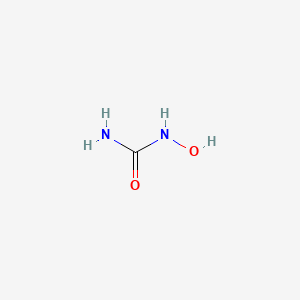
|
||||
| Drug Resistance Disease(s) |
Disease(s) with Clinically Reported Resistance for This Drug
(1 diseases)
 Chronic myeloid leukemia [ICD-11: 2A20]
[1]
Disease(s) with Resistance Information Discovered by Cell Line Test for This Drug
(1 diseases)
Neuroblastoma [ICD-11: 2A00]
[2]
|
||||
| Target | Ribonucleoside-diphosphate reductase M2 (RRM2) | RIR2_HUMAN | [1] | ||
| Click to Show/Hide the Molecular Information and External Link(s) of This Drug | |||||
| Formula |
CH4N2O2
|
||||
| IsoSMILES |
C(=O)(N)NO
|
||||
| InChI |
1S/CH4N2O2/c2-1(4)3-5/h5H,(H3,2,3,4)
|
||||
| InChIKey |
VSNHCAURESNICA-UHFFFAOYSA-N
|
||||
| PubChem CID | |||||
| ChEBI ID | |||||
| TTD Drug ID | |||||
| VARIDT ID | |||||
| DrugBank ID | |||||
Type(s) of Resistant Mechanism of This Drug
 EADR: Epigenetic Alteration of DNA, RNA or Protein
Drug Resistance Data Categorized by Their Corresponding Diseases
ICD-02: Benign/in-situ/malignant neoplasm
Brain cancer [ICD-11: 2A00]
| Drug Resistance Data Categorized by Their Corresponding Mechanisms | ||||
|
Epigenetic Alteration of DNA, RNA or Protein (EADR)
|
||||
| Key Molecule: hsa-miR-27a | [2] | |||
| Resistant Disease | Neuroblastoma [ICD-11: 2A00.02] | |||
| Molecule Alteration | Expression | Up-regulation |
||
| Experimental Note | Revealed Based on the Cell Line Data | |||
| In Vitro Model | A2780DX5 cells | Ovary | Homo sapiens (Human) | CVCL_4T98 |
| Experiment for Molecule Alteration |
MiRNA microarray profiling | |||
| Experiment for Drug Resistance |
MTT assay | |||
| Mechanism Description | We report here that microRNAs miR-27a and miR-451 are involved in activating the expression of P-glycoprotein, the MDR1 gene product that confers cancer cell resistance to a broad range of chemotherapeutics. We showed that expressions of miR-27a and miR-451 were up-regulated in multidrug resistant (MDR) cancer cell lines A2780DX5 and KB-V1, as compared with their parental lines A2780 and KB-3-1. Treatment of A2780DX5 cells with the antagomirs of miR-27a or miR-451 decreased the expression of P-glycoprotein and MDR1 mRNA. In contrast, the mimics of miR-27a and miR-451 increased MDR1 expression in the parental cells A2780. | |||
| Key Molecule: hsa-miR-451a | [2] | |||
| Resistant Disease | Neuroblastoma [ICD-11: 2A00.02] | |||
| Molecule Alteration | Expression | Up-regulation |
||
| Experimental Note | Revealed Based on the Cell Line Data | |||
| In Vitro Model | A2780DX5 cells | Ovary | Homo sapiens (Human) | CVCL_4T98 |
| Experiment for Molecule Alteration |
MiRNA microarray profiling | |||
| Experiment for Drug Resistance |
MTT assay | |||
| Mechanism Description | We report here that microRNAs miR-27a and miR-451 are involved in activating the expression of P-glycoprotein, the MDR1 gene product that confers cancer cell resistance to a broad range of chemotherapeutics. We showed that expressions of miR-27a and miR-451 were up-regulated in multidrug resistant (MDR) cancer cell lines A2780DX5 and KB-V1, as compared with their parental lines A2780 and KB-3-1. Treatment of A2780DX5 cells with the antagomirs of miR-27a or miR-451 decreased the expression of P-glycoprotein and MDR1 mRNA. In contrast, the mimics of miR-27a and miR-451 increased MDR1 expression in the parental cells A2780. | |||
References
If you find any error in data or bug in web service, please kindly report it to Dr. Sun and Dr. Yu.