
Drug Information
Drug (ID: DG00095) and It's Reported Resistant Information
| Name |
Tamoxifen
|
||||
|---|---|---|---|---|---|
| Synonyms |
Tamoxifen; 10540-29-1; trans-Tamoxifen; Crisafeno; Soltamox; Tamoxifene; Diemon; Tamoxifenum; Tamoxifeno; Tamizam; Istubol; Tamoxen; Citofen; Oncomox; Valodex; Retaxim; Tamoxifene [INN-French]; Tamoxifenum [INN-Latin]; Tamoxifeno [INN-Spanish]; Tamoxifen (Z); Tamoxifen and its salts; Tamoxifen [INN:BAN]; ICI-46474; ICI 47699; TRANS FORM OF TAMOXIFEN; CCRIS 3275; UNII-094ZI81Y45; HSDB 6782; CHEMBL83; EINECS 234-118-0; 1-p-beta-Dimethylaminoethoxyphenyl-trans-1,2-diphenylbut-1-ene; Citofen; Nourytam; Novaldex; Tamone; Tamoxifeno;Tamoxifenum; Tomaxithen; Gen-Tamoxifen; Istubal (TN); Nolvadex (TN); Nolvadex-D; Novo-Tamoxifen; Pms-Tamoxifen; Tamoplex (TN); Tamoxifen (INN); Tamoxifen (TN); Trans-Tamoxifen; Valodex (TN); TAMOXIFEN (TAMOXIFEN CITRATE (54965-24-1)); Trans-2-[4-(1,2-Diphenyl-1-butenyl)phenoxy]-N,N-dimethylethylamine; (Z)-1-(p-Dimethylaminoethoxyphenyl)-1,2-diphenyl-1-butene; (Z)-2-(4-(1,2-Diphenyl-1-butenyl)phenoxy)-N,N-dimethylethanamine; (Z)-2-(4-(1,2-diphenylbut-1-enyl)phenoxy)-N,N-dimethylethanamine; (Z)-2-(para-(1,2-Diphenyl-1-butenyl)phenoxy)-N,N-dimethylamine (IUPAC); (Z)-2-[4-(1,2)-DIPHENYL-1-BUTENYL)-PHENOXY]-N,N-DIMETHYLETHANAMINE; (Z)-2-[p-(1,2-Diphenyl-1-butenyl)phenoxy]-N,N-dimethylethylamine; 1-p-beta-Dimethylamino-ethoxyphenyl-trans-1,2-diphenylbut-1-ene; 1-para-beta-Dimethylaminoethoxyphenyl-trans-1,2-diphenylbut-1-ene; 2-[4-[(Z)-1,2-diphenylbut-1-enyl]phenoxy]-N,N-dimethylethanamine; 2-{4-[(1Z)-1,2-diphenylbut-1-en-1-yl]phenoxy}-N,N-dimethylethanamine; Tamoxifen (Hormonal therapy); [3H]tamoxifen
Click to Show/Hide
|
||||
| Indication |
In total 1 Indication(s)
|
||||
| Structure |
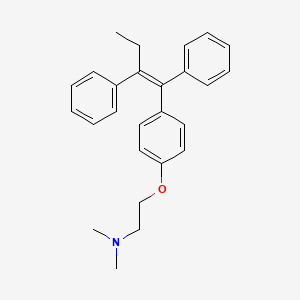
|
||||
| Drug Resistance Disease(s) |
Disease(s) with Clinically Reported Resistance for This Drug
(3 diseases)
 Breast cancer [ICD-11: 2C60]
[2]
Lung cancer [ICD-11: 2C25]
[3]
Ovarian cancer [ICD-11: 2C73]
[3]
Disease(s) with Resistance Information Discovered by Cell Line Test for This Drug
(1 diseases)
Breast cancer [ICD-11: 2C60]
[2]
|
||||
| Target | Estrogen receptor (ESR) | ESR1_HUMAN | [1] | ||
| Click to Show/Hide the Molecular Information and External Link(s) of This Drug | |||||
| Formula |
C26H29NO
|
||||
| IsoSMILES |
CC/C(=C(\\C1=CC=CC=C1)/C2=CC=C(C=C2)OCCN(C)C)/C3=CC=CC=C3
|
||||
| InChI |
1S/C26H29NO/c1-4-25(21-11-7-5-8-12-21)26(22-13-9-6-10-14-22)23-15-17-24(18-16-23)28-20-19-27(2)3/h5-18H,4,19-20H2,1-3H3/b26-25-
|
||||
| InChIKey |
NKANXQFJJICGDU-QPLCGJKRSA-N
|
||||
| PubChem CID | |||||
| ChEBI ID | |||||
| TTD Drug ID | |||||
| VARIDT ID | |||||
| DrugBank ID | |||||
Type(s) of Resistant Mechanism of This Drug due to Structure Alteration
 ADTT: Aberration of the Drug's Therapeutic Target
Drug Resistance Data Categorized by Their Corresponding Diseases
ICD-02: Benign/in-situ/malignant neoplasm
Breast cancer [ICD-11: 2C60]
| Drug Resistance Data Categorized by Their Corresponding Mechanisms | |||||||||||||
|
Aberration of the Drug's Therapeutic Target (ADTT)
|
|||||||||||||
| Key Molecule: Estrogen receptor alpha (ESR1) | [4], [5], [6] | ||||||||||||
| Resistant Disease | Breast cancer [ICD-11: 2C60.3] | ||||||||||||
| Molecule Alteration | Missense mutation | p.Y537S |
|||||||||||
| Wild Type Structure | Method: X-ray diffraction | Resolution: 1.60 Å | |||||||||||
| Mutant Type Structure | Method: X-ray diffraction | Resolution: 1.50 Å | |||||||||||
| Download The Information of Sequence | Download The Structure File | ||||||||||||
-
-
M
-
D
-
P
-
M
-
I
-
K
300
|
-
R
-
S
-
K
-
K
-
N
-
S
-
L
-
A
-
L
S
S
310
|
L
L
T
T
A
A
D
D
Q
Q
M
M
V
V
S
S
A
A
L
L
320
|
L
L
D
D
A
A
E
E
P
P
P
P
I
I
L
L
Y
Y
S
S
330
|
E
E
Y
Y
D
D
P
P
T
T
R
R
P
P
F
F
S
S
E
E
340
|
A
A
S
S
M
M
M
M
G
G
L
L
L
L
T
T
N
N
L
L
350
|
A
A
D
D
R
R
E
E
L
L
V
V
H
H
M
M
I
I
N
N
360
|
W
W
A
A
K
K
R
R
V
V
P
P
G
G
F
F
V
V
D
D
370
|
L
L
T
T
L
L
H
H
D
D
Q
Q
V
V
H
H
L
L
L
L
380
|
E
E
C
-
A
A
W
W
L
L
E
E
I
I
L
L
M
M
I
I
390
|
G
G
L
L
V
V
W
W
R
R
S
S
M
M
E
E
H
H
P
P
400
|
G
G
K
K
L
L
L
L
F
F
A
A
P
P
N
N
L
L
L
L
410
|
L
L
D
D
R
R
N
N
Q
Q
G
G
K
K
C
-
V
V
E
E
420
|
G
G
M
M
V
V
E
E
I
I
F
F
D
D
M
M
L
L
L
L
430
|
A
A
T
T
S
S
S
S
R
R
F
F
R
R
M
M
M
M
N
N
440
|
L
L
Q
Q
G
G
E
E
E
E
F
F
V
V
C
C
L
L
K
K
450
|
S
S
I
I
I
I
L
L
L
L
N
N
S
S
G
G
V
V
Y
Y
460
|
T
T
F
F
L
L
S
S
S
S
T
T
L
L
K
K
S
S
L
L
470
|
E
E
E
E
K
K
D
D
H
H
I
I
H
H
R
R
V
V
L
L
480
|
D
D
K
K
I
I
T
T
D
D
T
T
L
L
I
I
H
H
L
L
490
|
M
M
A
A
K
K
A
A
G
G
L
L
T
T
L
L
Q
Q
Q
Q
500
|
Q
Q
H
H
Q
Q
R
R
L
L
A
A
Q
Q
L
L
L
L
L
L
510
|
I
I
L
L
S
S
H
H
I
I
R
R
H
H
M
M
S
S
N
N
520
|
K
K
G
G
M
M
E
E
H
H
L
L
Y
Y
S
S
M
M
K
K
530
|
C
-
K
K
N
N
V
V
V
V
P
P
L
L
Y
S
D
D
L
L
540
|
L
L
L
L
E
E
M
M
L
L
D
D
A
A
H
H
R
R
L
L
550
|
H
H
A
A
P
P
T
T
S
S
|
|||||||||||||
| Experimental Note | Identified from the Human Clinical Data | ||||||||||||
| Cell Pathway Regulation | PI3K signaling pathway | Activation | hsa04151 | ||||||||||
| In Vivo Model | A retrospective survey in conducting clinical studies | Homo sapiens | |||||||||||
| Experiment for Molecule Alteration |
Whole-exome sequencing assay; SNP Array profiling assay | ||||||||||||
| Experiment for Drug Resistance |
Tumor biopsy assay | ||||||||||||
| Mechanism Description | Mutations in ESR1 were detected in 4% of cancers and clustered in the ligand-binding domain. These included p.Tyr537(Cys/Asn/Ser) mutations (three patients) that have been shown to cause constitutive activation and resistance to tamoxifen therapy in breast cancer. | ||||||||||||
| Key Molecule: Estrogen receptor alpha (ESR1) | [5] | ||||||||||||
| Resistant Disease | Breast cancer [ICD-11: 2C60.3] | ||||||||||||
| Molecule Alteration | Missense mutation | p.D538G |
|||||||||||
| Wild Type Structure | Method: X-ray diffraction | Resolution: 1.60 Å | |||||||||||
| Mutant Type Structure | Method: X-ray diffraction | Resolution: 1.90 Å | |||||||||||
| Download The Information of Sequence | Download The Structure File | ||||||||||||
-
-
V
-
D
-
L
-
G
-
T
-
E
290
|
-
N
-
L
-
Y
-
F
-
Q
-
S
-
N
-
A
-
M
-
K
300
|
-
R
-
S
-
K
-
K
-
N
-
S
-
L
-
A
-
L
S
S
310
|
L
L
T
T
A
A
D
D
Q
Q
M
M
V
V
S
S
A
A
L
L
320
|
L
L
D
D
A
A
E
E
P
P
P
P
I
I
L
L
Y
Y
S
S
330
|
E
E
Y
Y
D
D
P
P
T
T
R
R
P
P
F
F
S
S
E
E
340
|
A
A
S
S
M
M
M
M
G
G
L
L
L
L
T
T
N
N
L
L
350
|
A
A
D
D
R
R
E
E
L
L
V
V
H
H
M
M
I
I
N
N
360
|
W
W
A
A
K
K
R
R
V
V
P
P
G
G
F
F
V
V
D
D
370
|
L
L
T
T
L
L
H
H
D
D
Q
Q
V
V
H
H
L
L
L
L
380
|
E
E
C
C
A
A
W
W
L
L
E
E
I
I
L
L
M
M
I
I
390
|
G
G
L
L
V
V
W
W
R
R
S
S
M
M
E
E
H
H
P
P
400
|
G
G
K
K
L
L
L
L
F
F
A
A
P
P
N
N
L
L
L
L
410
|
L
L
D
D
R
R
N
N
Q
Q
G
G
K
K
C
C
V
V
E
E
420
|
G
G
M
M
V
V
E
E
I
I
F
F
D
D
M
M
L
L
L
L
430
|
A
A
T
T
S
S
S
S
R
R
F
F
R
R
M
M
M
M
N
N
440
|
L
L
Q
Q
G
G
E
E
E
E
F
F
V
V
C
C
L
L
K
K
450
|
S
S
I
I
I
I
L
L
L
L
N
N
S
S
G
G
V
V
Y
Y
460
|
T
T
F
F
L
L
S
S
S
S
T
T
L
L
K
K
S
S
L
L
470
|
E
E
E
E
K
K
D
D
H
H
I
I
H
H
R
R
V
V
L
L
480
|
D
D
K
K
I
I
T
T
D
D
T
T
L
L
I
I
H
H
L
L
490
|
M
M
A
A
K
K
A
A
G
G
L
L
T
T
L
L
Q
Q
Q
Q
500
|
Q
Q
H
H
Q
Q
R
R
L
L
A
A
Q
Q
L
L
L
L
L
L
510
|
I
I
L
L
S
S
H
H
I
I
R
R
H
H
M
M
S
S
N
N
520
|
K
K
G
G
M
M
E
E
H
H
L
L
Y
Y
S
S
M
M
K
K
530
|
C
C
K
K
N
N
V
V
V
V
P
P
L
L
Y
Y
D
G
L
L
540
|
L
L
L
L
E
E
M
M
L
L
D
D
A
A
H
H
R
R
L
L
550
|
H
H
A
A
P
P
T
T
S
S
|
|||||||||||||
| Experimental Note | Identified from the Human Clinical Data | ||||||||||||
| In Vivo Model | A retrospective survey in conducting clinical studies | Homo sapiens | |||||||||||
| Experiment for Molecule Alteration |
Next-generation sequencing assay | ||||||||||||
| Mechanism Description | In our analysis of frequently mutated oncogenes and tumor suppressors, ESR1 mutations stood out as a common and plausible event that could contribute to resistance. We found that the mutations in both Tyr537 and Asp538 strongly promoted ER signaling in absence of ligand. This was observed biochemically as increased phosphorylation on S118, increased association with AIB1, and diminished sensitivity to HSP90 inhibitors. Functionally, the mutations in vitro promoted the expression of classical ER target genes in the absence of hormone. | ||||||||||||
| Key Molecule: Estrogen receptor alpha (ESR1) | [4], [6], [7] | ||||||||||||
| Resistant Disease | Breast cancer [ICD-11: 2C60.3] | ||||||||||||
| Molecule Alteration | Missense mutation | p.D538G |
|||||||||||
| Wild Type Structure | Method: X-ray diffraction | Resolution: 1.60 Å | |||||||||||
| Mutant Type Structure | Method: X-ray diffraction | Resolution: 1.90 Å | |||||||||||
| Download The Information of Sequence | Download The Structure File | ||||||||||||
-
-
V
-
D
-
L
-
G
-
T
-
E
290
|
-
N
-
L
-
Y
-
F
-
Q
-
S
-
N
-
A
-
M
-
K
300
|
-
R
-
S
-
K
-
K
-
N
-
S
-
L
-
A
-
L
S
S
310
|
L
L
T
T
A
A
D
D
Q
Q
M
M
V
V
S
S
A
A
L
L
320
|
L
L
D
D
A
A
E
E
P
P
P
P
I
I
L
L
Y
Y
S
S
330
|
E
E
Y
Y
D
D
P
P
T
T
R
R
P
P
F
F
S
S
E
E
340
|
A
A
S
S
M
M
M
M
G
G
L
L
L
L
T
T
N
N
L
L
350
|
A
A
D
D
R
R
E
E
L
L
V
V
H
H
M
M
I
I
N
N
360
|
W
W
A
A
K
K
R
R
V
V
P
P
G
G
F
F
V
V
D
D
370
|
L
L
T
T
L
L
H
H
D
D
Q
Q
V
V
H
H
L
L
L
L
380
|
E
E
C
C
A
A
W
W
L
L
E
E
I
I
L
L
M
M
I
I
390
|
G
G
L
L
V
V
W
W
R
R
S
S
M
M
E
E
H
H
P
P
400
|
G
G
K
K
L
L
L
L
F
F
A
A
P
P
N
N
L
L
L
L
410
|
L
L
D
D
R
R
N
N
Q
Q
G
G
K
K
C
C
V
V
E
E
420
|
G
G
M
M
V
V
E
E
I
I
F
F
D
D
M
M
L
L
L
L
430
|
A
A
T
T
S
S
S
S
R
R
F
F
R
R
M
M
M
M
N
N
440
|
L
L
Q
Q
G
G
E
E
E
E
F
F
V
V
C
C
L
L
K
K
450
|
S
S
I
I
I
I
L
L
L
L
N
N
S
S
G
G
V
V
Y
Y
460
|
T
T
F
F
L
L
S
S
S
S
T
T
L
L
K
K
S
S
L
L
470
|
E
E
E
E
K
K
D
D
H
H
I
I
H
H
R
R
V
V
L
L
480
|
D
D
K
K
I
I
T
T
D
D
T
T
L
L
I
I
H
H
L
L
490
|
M
M
A
A
K
K
A
A
G
G
L
L
T
T
L
L
Q
Q
Q
Q
500
|
Q
Q
H
H
Q
Q
R
R
L
L
A
A
Q
Q
L
L
L
L
L
L
510
|
I
I
L
L
S
S
H
H
I
I
R
R
H
H
M
M
S
S
N
N
520
|
K
K
G
G
M
M
E
E
H
H
L
L
Y
Y
S
S
M
M
K
K
530
|
C
C
K
K
N
N
V
V
V
V
P
P
L
L
Y
Y
D
G
L
L
540
|
L
L
L
L
E
E
M
M
L
L
D
D
A
A
H
H
R
R
L
L
550
|
H
H
A
A
P
P
T
T
S
S
|
|||||||||||||
| Experimental Note | Identified from the Human Clinical Data | ||||||||||||
| In Vivo Model | A retrospective survey in conducting clinical studies | Homo sapiens | |||||||||||
| Experiment for Molecule Alteration |
Circulating cell-free DNA assay; Liquid biopsy assay; Droplet digital PCR assay; Next generation assay | ||||||||||||
| Experiment for Drug Resistance |
Progression-free survival assay; Overall survival assay | ||||||||||||
| Mechanism Description | Recent studies have also highlighted the utility of ex vivo culturing of CTCs as a method of individualized drug susceptibility testing. Using this method, the authors found that CTCs have various mutations (including the p.D538G and p.Y537S ESR1 mutations), and showed that low-dose administration of the HSP90 inhibitor STA9090 alone or in combination with raloxifene and fulvestrant has growth-inhibitory effects. | ||||||||||||

References
If you find any error in data or bug in web service, please kindly report it to Dr. Sun and Dr. Yu.